

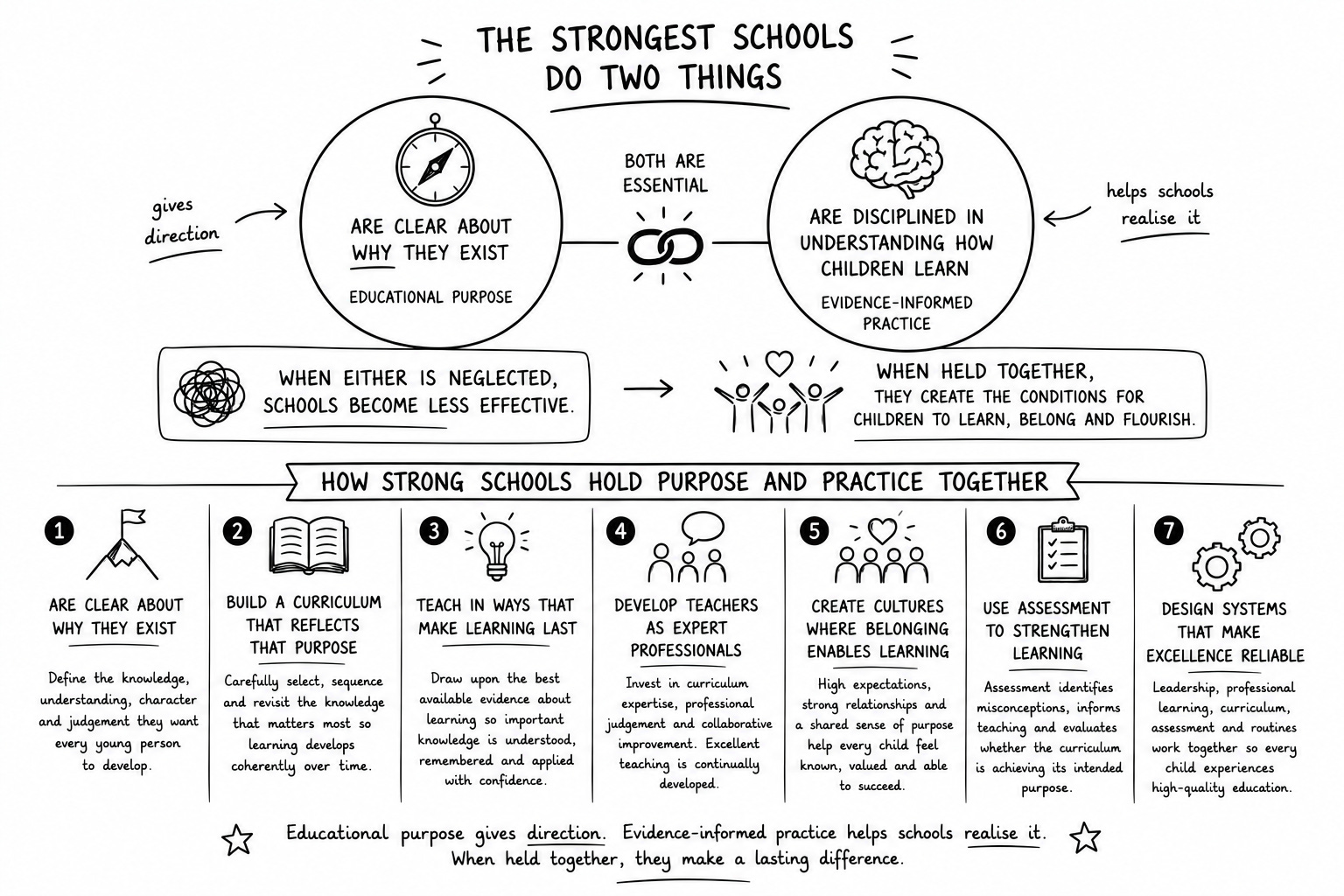
Throughout my career, I have become convinced that the strongest schools do two things exceptionally well. They are absolutely clear about why they exist, and they are equally disciplined in understanding how children learn. Those two ideas have shaped much of my own thinking about school improvement because they influence almost every decision leaders make. Educational purpose provides direction, while evidence-informed practice helps schools realise it. When they are held together, they create the conditions in which children learn well, feel they belong and are able to flourish.
Over recent months I have found myself reflecting on two educational conversations. Here in Australia, much of what I have been reading has focused on implementation, the science of learning and strengthening curriculum and teaching. At the same time, many of the educational voices I continue to follow in England have been writing about belonging, relationships and the broader purpose of education. Although these conversations have different emphases, I have found myself thinking that they are much more closely connected than they sometimes appear. Strong schools do not separate purpose from practice because each depends upon the other.
My experience of leading schools has continually reinforced this belief. I have seen the difference that a deeper understanding of how children learn can make to children’s outcomes. Carefully sequenced curricula, explicit teaching, retrieval practice and deliberate practice help pupils remember more, develop greater confidence and achieve more over time. Understanding learning has transformed educational practice because it helps teachers make better decisions about what they teach, when they teach it and how they help learning endure.
Leading a multi-academy trust made up predominantly of Church of England schools reinforced something equally important. Every Church school is shaped by a theologically rooted Christian vision that explains who it exists to serve and the contribution it hopes to make to its community. Through the Statutory Inspection of Anglican and Methodist Schools (SIAMS), schools are expected to demonstrate how that vision influences leadership, curriculum, relationships and everyday decision-making. Purpose is not simply articulated; it is expected to be lived.
Working within that context also meant regularly preparing for both Ofsted and SIAMS inspections, often within relatively short periods of one another. I think those two inspection frameworks complemented each other well. Ofsted focused our attention on the quality of education and the extent to which children were learning successfully. SIAMS challenged us to demonstrate how the school’s vision shaped every aspect of school life and enabled every child and adult to flourish. We did not have the option of concentrating on one while neglecting the other, and I believe our schools were stronger because of it.
The schools that achieved the greatest and most sustainable improvements knew why they existed and worked relentlessly to ensure that curriculum, teaching, assessment, relationships and leadership reflected that purpose. Understanding how children learn explained how to improve learning. Educational purpose explained why that learning mattered. The science of learning was not the purpose of our work; it was one of the most powerful ways of realising it.
Without a clear educational purpose, implementation can become an exercise in consistency, compliance and technical precision. Without a deep understanding of how children learn, even the strongest vision struggles to improve children’s outcomes. The schools that make the greatest difference recognise that both deserve the same degree of intellectual rigour, leadership attention and continual refinement.
How strong schools hold purpose and practice together
From my experience, successful schools share a small number of characteristics that consistently hold educational purpose and evidence-informed practice together. In particular, they:
Are clear about why they exist. They define the knowledge, understanding, character and judgement they want every young person to develop, and that purpose informs strategic decisions throughout the organisation.
Build a curriculum that reflects that purpose. They carefully select, sequence and revisit the knowledge that matters most so that learning develops coherently over time.
Teach in ways that make learning last. They draw upon the best available evidence about learning so that important knowledge is understood, remembered and applied with confidence.
Develop teachers as expert professionals. They invest in curriculum expertise, professional judgement and collaborative improvement because excellent teaching is continually developed.
Create cultures where belonging enables learning. High expectations, strong relationships and a shared sense of purpose help every child feel known, valued and able to succeed.
Use assessment to strengthen learning. Assessment identifies misconceptions, informs teaching and evaluates whether the curriculum is achieving its intended purpose.
Design systems that make excellence reliable. Leadership, professional learning, curriculum, assessment and organisational routines work together so that every child consistently experiences high-quality education.
School leaders will always have immediate priorities demanding their attention. That is simply the reality of leadership. Even so, I think it is worth returning regularly to two ideas that sit beneath every improvement decision. Why does this school exist? How do children learn most successfully?
The first provides direction. The second helps us realise it. When schools remain disciplined in both, they are far more likely to improve outcomes that endure, strengthen belonging and make a lasting contribution to the communities they serve.
Get in touch - lois@reliable-excellence.com
References
Church of England Education Office. (2023). The Statutory Inspection of Anglican and Methodist Schools (SIAMS): Evaluation Schedule. Church House Publishing.
Education Endowment Foundation. (2021). Cognitive science approaches in the classroom: A review of the evidence. Education Endowment Foundation.
Ofsted. (2023). School inspection handbook. Ofsted.
Sweller, J., Ayres, P., & Kalyuga, S. (2011). Cognitive load theory. Springer.