

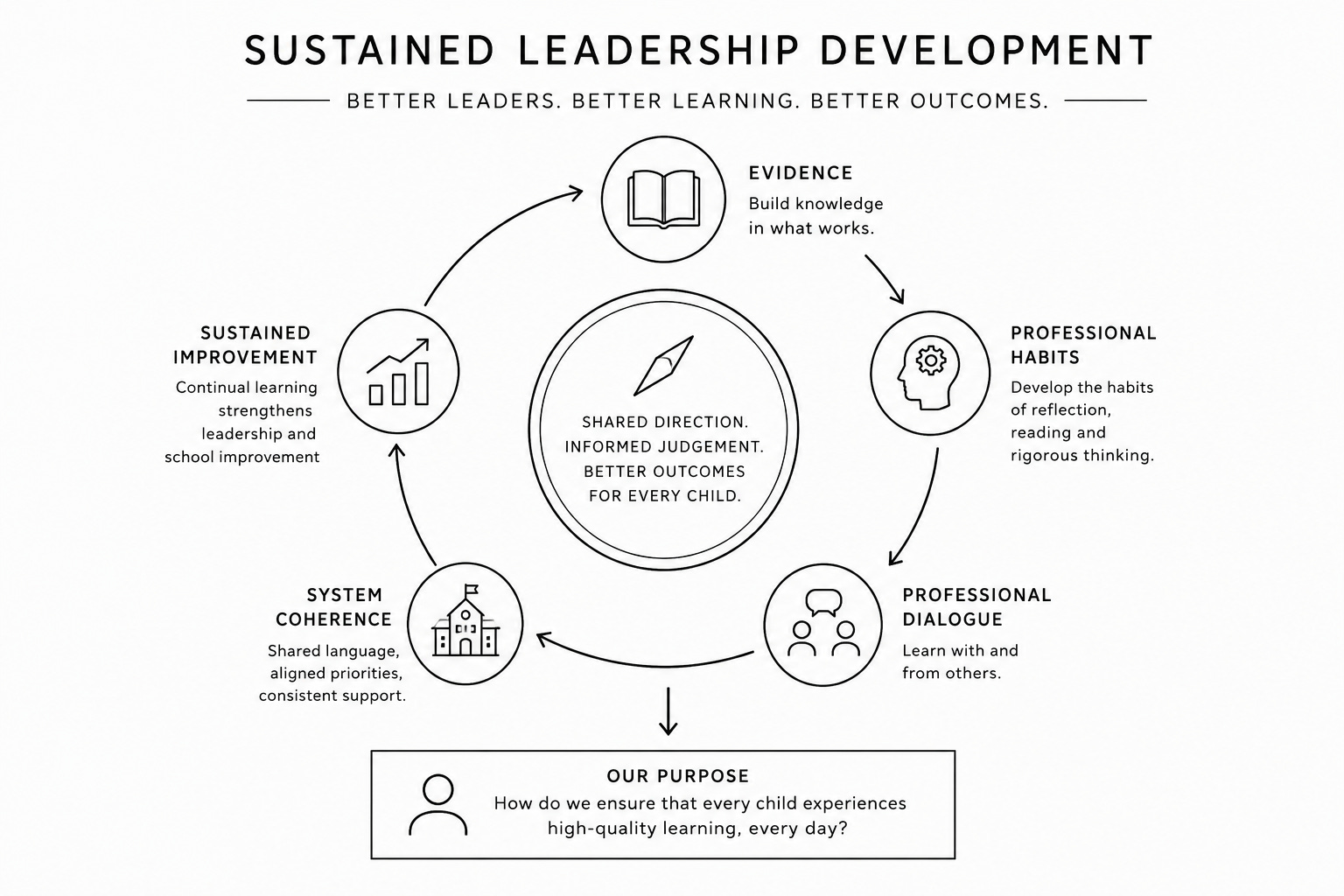
Reliable Excellence is built around a single guiding question: How do we ensure that every child experiences high-quality learning, every day? Schools are where that ambition becomes reality, but schools do not exist in isolation. They sit within wider education systems that shape priorities, influence professional thinking and determine where leaders invest their attention. If we want every child to experience successful learning, those wider systems also have a responsibility to support the continual development of the people leading schools.
As Paul Bambrick-Santoyo argues, the purpose of leadership is not simply to manage organisations but to improve outcomes for students. That requires leaders who are continually developing their own knowledge and judgement, rather than simply complying with external expectations.
In busy schools, compliance can become an understandable substitute for professional learning. Leaders are balancing safeguarding, behaviour, staffing, budgets, parental concerns and countless operational demands. Faced with this reality, education systems often respond by producing frameworks, templates, checklists and implementation guidance. These resources have an important role. Just as effective teaching provides scaffolding when pupils are learning something new, leaders also benefit from clear guidance when developing unfamiliar knowledge. Scaffolding helps us to begin learning, but it should not become the final destination.
Our ambition should not be to produce leaders who can faithfully follow a checklist. It should be to develop professional judgement: leaders who understand the evidence, can interpret their context and make thoughtful decisions about what their schools need. Frameworks may support learning, but they cannot replace the thinking that leadership demands.
Every school begins from a different starting point. One may be strengthening behaviour systems, another refining curriculum, or rebuilding after a period of instability. School improvement is always contextual. However, the principles that underpin successful learning remain consistent. One of the most valuable things an education system can do is reinforce those principles through a shared direction of travel, creating coherence while still allowing schools the professional autonomy to apply evidence intelligently within their own contexts.
England’s National Professional Qualifications (NPQs) are one attempt to achieve this. The NPQ suite provides nationally recognised leadership development programmes for teachers and leaders at different stages of their careers, from aspiring middle leaders through to executive leadership. Over the course of my career, I have completed the NPQ Middle Leadership, NPQ Senior Leadership, NPQ Headship and NPQ Executive Leadership and facilitated elements of the programmes myself.
Like any large-scale national initiative, NPQs have attracted criticism. Some have questioned aspects of the curriculum, others the consistency of delivery or their relevance across very different school contexts. Those debates are both inevitable and healthy. Developing leadership across an entire education system is a significant undertaking and no programme will ever meet every leader’s needs perfectly. That should not prevent us from recognising the value that sustained national leadership development can bring.
The greatest value of the NPQs is their commitment to sustained professional learning. Rather than treating leadership development as a one-off event, the programmes continually bring leaders back to the evidence underpinning effective leadership, teaching, implementation and school improvement. Ideas are revisited at different stages of a career, allowing understanding to deepen as experience grows and creating opportunities to refine thinking over time.
That sustained engagement also develops professional habits. Reading educational research becomes part of leadership practice rather than something reserved for quieter periods. Assignments require ideas to be justified with evidence, implementation to be thought through carefully and professional judgement to be articulated clearly. Those habits often remain long after each qualification has finished because they become part of how leaders approach their work.
Equally valuable is the professional dialogue that develops throughout the programmes. Some of the richest learning comes through discussions with facilitators and fellow leaders who understand the realities of leading schools. Those conversations challenge assumptions, test ideas against practice and create a shared professional language that frequently continues well beyond the programmes themselves.
One example stands out from my time as CEO. Across the Trust, schools were supporting children with a wide range of additional needs and were at very different stages in developing inclusive practice. We already had examples of strong practice within individual schools, but engaging with the NPQEL prompted me to interrogate that practice more rigorously through an evidence-informed and implementation science lens. It wasn’t about replacing what we were doing; it was about strengthening my professional judgement. The programme encouraged me to think more carefully about why an approach should work, what evidence supported it, what conditions needed to be in place for success, where implementation might falter and how consistency could be achieved across schools with very different contexts. That strengthened both the strategy itself and our confidence that it could be implemented effectively and sustainably across the Trust.
On reflection, what stands out most is that this learning continued throughout every stage of my career, including periods spent leading schools facing significant challenge where time and budgets for professional development were often extremely limited. Even when the immediate demands of leadership threatened to consume every available hour, there remained an expectation that learning would continue.
That expectation reflects what we know about learning itself. Whether we are developing pupils or developing leaders, learning is rarely transformed by isolated events. It develops through repeated retrieval, deliberate practice, reflection, feedback and opportunities to revisit important ideas over time. Sustained professional development applies those same principles to leadership. By continually reinforcing the evidence, creating shared language and encouraging ongoing professional dialogue, national leadership programmes help leaders deepen their understanding rather than simply accumulate information.
Individual schools cannot create that coherence on their own. National leadership development has the potential to establish shared language, strengthen understanding of evidence-informed practice, support thoughtful implementation and encourage leaders to continue learning throughout their careers. It cannot, and should not, produce identical schools. Instead, it provides a common foundation from which leaders can exercise informed professional judgement within their own contexts while contributing to a shared direction of travel across the wider education system.
No national programme will ever transform every leader or solve every challenge facing schools. Leadership remains deeply contextual, and professional judgement can never be reduced to a framework. However, systems that invest in sustained leadership development are far more likely to create coherence than those that rely on isolated courses or occasional conferences.
Ultimately, the purpose is not to produce leaders who know the right answers. It is to develop leaders who continue asking better questions, refining their practice and learning throughout their careers. If our collective ambition is to ensure that every child experiences high-quality learning, every day, then sustained leadership development must be recognised as an essential part of creating the conditions in which that ambition can become reality.
References
Bambrick-Santoyo, P. (2018). Leverage Leadership 2.0: A Practical Guide to Building Exceptional Schools. Jossey-Bass.
Coe, R., Aloisi, C., Higgins, S., & Major, L. E. (2014). What Makes Great Teaching? Review of the Underpinning Research. Sutton Trust.
Didau, D. (2026). Better Schools, Better Teachers? The Learning Spy.
Education Endowment Foundation. (2019). Putting Evidence to Work: A School’s Guide to Implementation.
Kraft, M. A., & Papay, J. P. (2014). Can Professional Environments in Schools Promote Teacher Development? Explaining Heterogeneity in Returns to Teaching Experience. Educational Evaluation and Policy Analysis, 36(4), 476–500.