


Reliable Excellence explores an important question:
How do we ensure that every child experiences high-quality learning, every day?
When people talk about successful schools, they often talk about successful leaders. Stories of improvement frequently focus on individuals whose vision, determination and energy transformed an organisation. Leadership undoubtedly matters. Strong leaders establish direction, create momentum and influence the culture of the organisations they serve. However, what happens when the exceptional leader leaves?
This question matters because children only experience one education. They cannot wait for the right teacher, the right leader or the right initiative to arrive. If high-quality learning depends entirely upon exceptional individuals, then pupils’ experiences will inevitably vary. Sustainable improvement requires something more dependable. It requires leaders who create the conditions in which effective practice becomes commonplace.
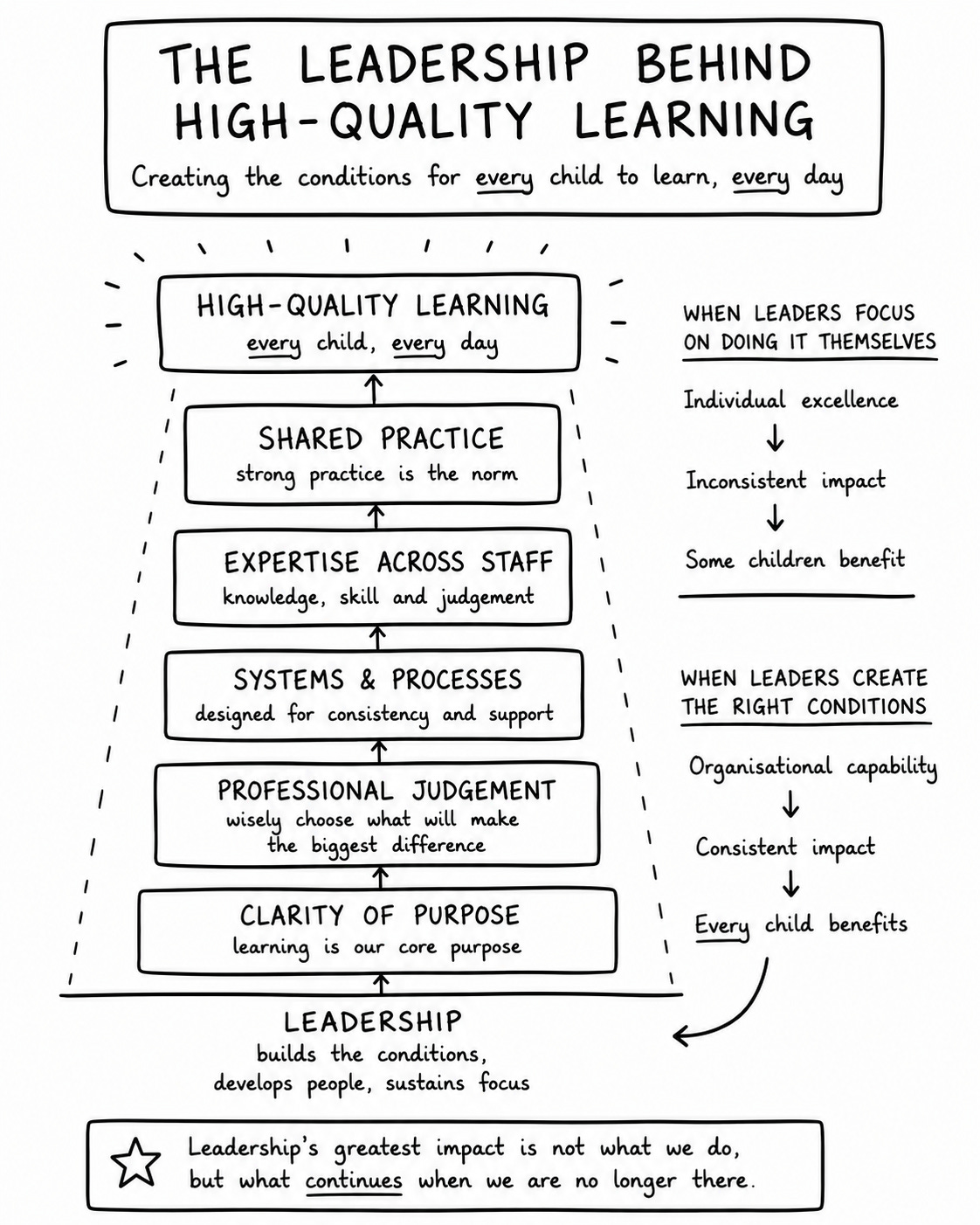
Schools and education organisations are complex environments. Hundreds of decisions are made every day by teachers, support staff, middle leaders and senior leaders. No individual, regardless of their talent or experience, can directly influence every interaction that shapes a child’s experience. Lasting improvement therefore depends less on what leaders do personally and more on the conditions they create for others to succeed.
Creating those conditions begins with clarity of purpose. Schools perform many important functions and operate within increasingly complex environments. Attendance, safeguarding, wellbeing, staffing, budgets and accountability all demand attention. Effective leaders understand the importance of each of these responsibilities while maintaining a clear understanding of why the organisation exists. The central purpose of a school is learning. When decisions, priorities and resources are consistently connected back to that purpose, greater coherence begins to emerge.
Clarity of purpose provides direction, but direction alone does not improve outcomes. Improvement depends upon the expertise of the people working throughout the organisation. The quality of learning experienced by pupils is heavily influenced by the knowledge, skill and judgement of the adults who teach and support them. Leaders who create sustainable improvement therefore invest heavily in developing others. Professional learning becomes an ongoing process rather than a series of isolated events. Coaching, feedback, collaboration and deliberate practice help individuals refine their expertise over time, increasing the organisation’s overall capacity to improve outcomes for children.
As expertise develops, leaders face another challenge. Many schools contain examples of exceptional practice, yet excellence confined to individual classrooms does not guarantee that every child will benefit from it. Effective leaders therefore focus on helping strong practice become shared practice. Curriculum design, assessment approaches, professional learning and quality assurance processes work together to support consistency. Rather than relying upon a handful of exceptional individuals, organisations become increasingly capable of delivering high-quality experiences for all pupils.
Maintaining this focus requires both ambition and discipline. Every child deserves access to challenging learning, an ambitious curriculum and excellent teaching regardless of their background or circumstances. High expectations communicate what is possible, but expectations alone are insufficient. Teachers need support to develop their practice. Pupils need carefully designed instruction and appropriate scaffolding. Improvement becomes more likely when challenge and support exist alongside one another.
Modern leadership also requires strong professional judgement. Leaders have access to more information, research, resources and advice than at any point in history. Social media accelerates the spread of new ideas, while artificial intelligence can generate recommendations, plans and resources within seconds. Access to information is no longer the primary challenge. The challenge is deciding which ideas are worth pursuing, which align with organisational priorities and which are most likely to improve outcomes for children. Effective leaders remain curious and informed, but they also exercise discipline. They evaluate evidence carefully, consider how change will be implemented and focus attention on the approaches most likely to make a meaningful difference. Artificial intelligence may enhance access to information and increase organisational capacity, but it cannot replace professional judgement. Questions of purpose, values, relationships and culture remain fundamentally human responsibilities, requiring leaders to determine not only what can be done, but what should be done.
Viewed in this way, leadership becomes less about personal performance and more about organisational capability. Strong leaders recognise that their role is not simply to drive improvement themselves. Their role is to create the conditions in which improvement can occur throughout the organisation and continue over time. They build clarity, develop expertise, strengthen systems and create cultures in which people can succeed.
Children only experience one education. They cannot wait for the right teacher, the right leader or the right initiative to arrive. Creating the conditions for consistently high-quality learning requires leadership that develops people, builds capability and maintains an unwavering focus on learning. The most successful leaders understand that their greatest contribution is not simply improving an organisation themselves, but creating the conditions in which improvement can continue long after they have gone.
References
Bambrick-Santoyo, P. (2018). Leverage Leadership 2.0: A Practical Guide to Building Exceptional Schools. Jossey-Bass.
Bryk, A. S., Gomez, L. M., Grunow, A., & LeMahieu, P. G. (2015). Learning to Improve: How America’s Schools Can Get Better at Getting Better. Harvard Education Press.
Fullan, M. (2020). Leading in a Culture of Change (2nd ed.). Jossey-Bass.
Robinson, V. M. J. (2011). Student-Centered Leadership. Jossey-Bass.
Senge, P. M. (2006). The Fifth Discipline: The Art and Practice of the Learning Organization (Revised ed.). Doubleday.