


Reliable Excellence explores one important question:
How do we ensure every child experiences high-quality learning, every day?
One way to explore that question is to examine examples of educational improvement at scale. If a system succeeds in improving outcomes for large numbers of children, particularly those facing disadvantage, it can provide valuable insights into the conditions that make improvement possible.
England’s experience during the first two decades of this century provides an interesting example. During this period, outcomes improved substantially, particularly in London. Improvement was evident in both primary and secondary education. By the early 2010s, pupils in London primary schools were outperforming the national average in English and mathematics. Similar patterns emerged in secondary schools. Schools serving disadvantaged communities achieved outcomes that had previously seemed unlikely, and disadvantaged pupils in London began to outperform disadvantaged pupils elsewhere in England by a considerable margin. Research published by the Institute for Fiscal Studies found that disadvantaged pupils in Inner London were around 19 percentage points more likely to achieve five good GCSEs, including English and mathematics, than disadvantaged pupils elsewhere in England.
Explaining this improvement has generated considerable debate. Researchers have pointed to demographic changes, immigration patterns, changing communities and wider economic factors. Others have focused on policy reforms, accountability systems and school improvement programmes. The scale of the improvement suggests that no single explanation is likely to be sufficient.
One of the most striking features of this period was a growing determination to improve outcomes for all pupils, particularly those facing disadvantage. Educational outcomes became more visible and schools were increasingly expected to demonstrate impact. High expectations for disadvantaged pupils became a more prominent feature of professional and policy discussions. While accountability alone cannot improve outcomes, it helped create a shared focus across the system.
At the same time, schools became less isolated. Improvement increasingly became something that happened between schools as well as within them. Programmes such as London Challenge sought to connect schools to expertise and create networks through which effective practice could spread. Stronger schools worked alongside those facing greater challenges and experienced leaders were deployed to support schools requiring improvement. Expertise became more accessible and school improvement became a collective endeavour rather than an individual struggle.
Alongside this, significant investment was made in developing people. Leadership was increasingly viewed as a discipline that could be deliberately developed rather than simply acquired through experience. The National College for School Leadership expanded leadership development opportunities and the National Professional Qualifications became an increasingly important part of the leadership landscape. Organisations such as Future Leaders and Teaching Leaders emerged to identify and develop talented teachers and leaders capable of driving improvement in challenging contexts. Together, these initiatives helped build a pipeline of leadership talent across the system.
The profession also became more deliberate about attracting and developing talent. Teach First emerged as one of the most visible examples of this shift. By recruiting high-achieving graduates and placing them in schools serving disadvantaged communities, the programme sought to strengthen the workforce in areas where recruitment had historically been difficult. Many participants went on to become school leaders, contributing to the wider leadership capacity of the system.
Organisational capacity was also developing. Early academy trusts such as Ark and Harris demonstrated how expertise could be shared across groups of schools. Leadership development, curriculum resources, professional learning and school improvement capacity could be coordinated across multiple institutions. Effective approaches no longer needed to remain within individual schools. They could be refined, adapted and spread more widely. As trusts expanded, they created new mechanisms through which improvement could be sustained and scaled.
The infrastructure surrounding schools also evolved. Organisations focused on social mobility, educational research and school improvement became increasingly influential. The Sutton Trust played an important role in highlighting educational disadvantage and advocating for greater opportunity. The Education Endowment Foundation (EEF) was established with a £125 million endowment from the government to identify effective approaches for improving outcomes, particularly for disadvantaged pupils. Through large-scale trials, evidence reviews and practical guidance reports, the EEF became one of the most significant contributors to the evidence infrastructure supporting schools.
Research also became increasingly visible within professional conversations. Findings from cognitive science, curriculum research and implementation studies became more accessible to teachers and leaders. Professional development increasingly drew upon research evidence and organisations emerged to help schools translate evidence into classroom practice. Schools gained access to a growing body of knowledge about learning, teaching and implementation.
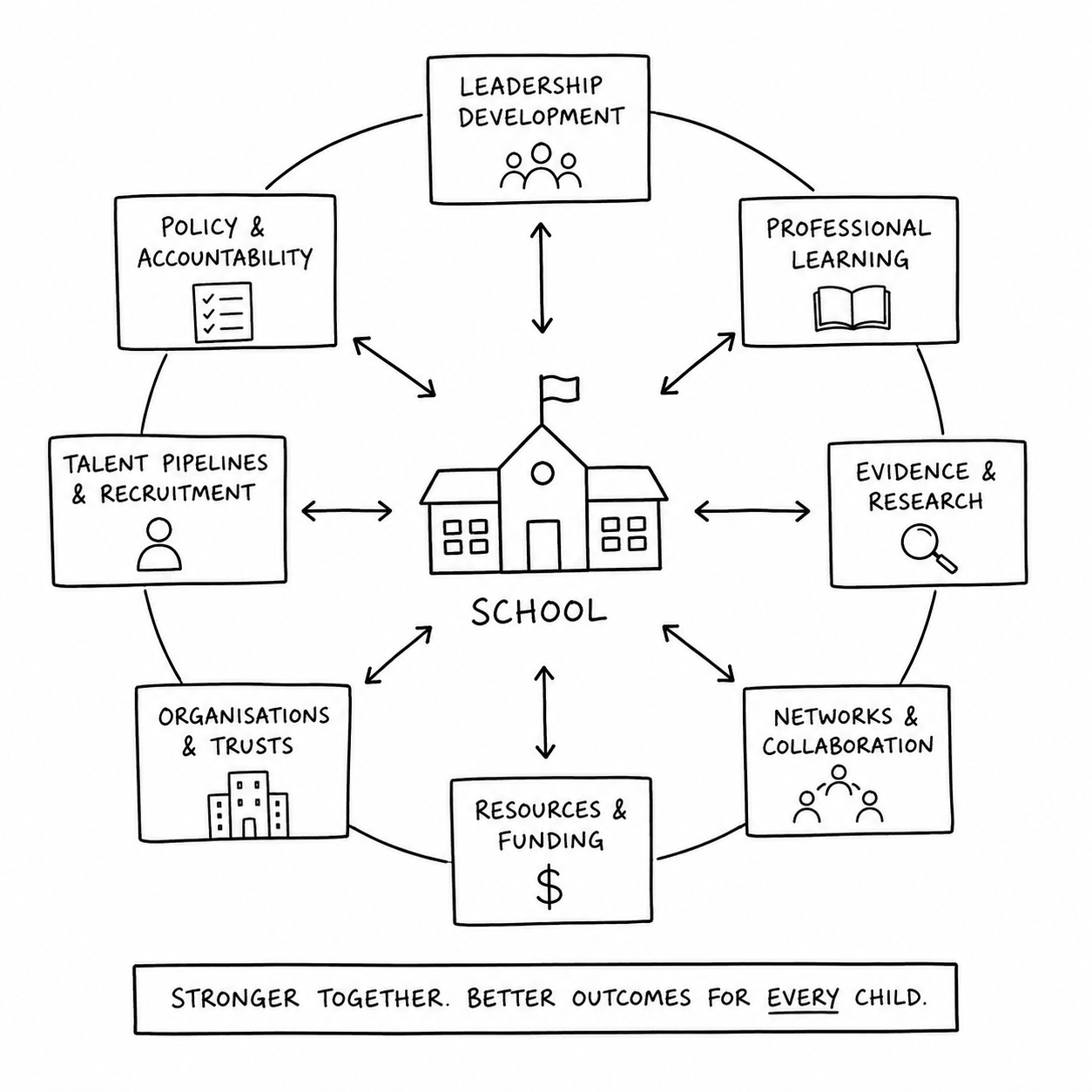
Viewed individually, each of these developments appears significant. Viewed collectively, they suggest the emergence of something larger. Schools operated within an ecosystem that generated knowledge, developed leadership, supported implementation, spread expertise and maintained a focus on pupil outcomes. Researchers produced evidence. Organisations translated evidence into practical approaches. Professional development providers built capability. School improvement programmes connected schools to expertise. Trusts created mechanisms through which effective practice could travel beyond individual institutions.
The improvement seen in London and across parts of England cannot be attributed to any single organisation or policy. Educational change is rarely that simple. The period is perhaps most notable for the number of organisations, programmes and institutions that were working towards similar goals. Their approaches differed and their priorities were not always identical, yet together they contributed to an environment in which improving outcomes for disadvantaged pupils became a sustained and system-wide endeavour.
The significance of this period is reflected not only in the improvements that occurred at the time, but also in the persistence of the so-called London effect. More than a decade later, London remains one of the highest-performing regions in England for disadvantaged pupils. Recent data shows that disadvantaged pupils in Inner London are substantially more likely to achieve strong GCSE outcomes in English and mathematics than disadvantaged pupils nationally. While the reasons remain contested, the pattern suggests that something more enduring than a single programme or policy may have taken place.
Looking back at this period highlights an important feature of educational improvement. High-quality learning depends upon what happens in classrooms, but the conditions that support that work are often created beyond the school gates. Leadership development, research, professional learning, school improvement support, networks and organisational capacity all influence what schools are able to achieve. If every child is to experience high-quality learning every day, attention must be paid not only to what happens within schools, but also to the ecosystem that surrounds them.
Get in touch - lois@reliable-excellence.com
References
Blanden, J., Greaves, E., Gregg, P., Macmillan, L., & Sibieta, L. (2015). Understanding the Improved Performance of Disadvantaged Pupils in London. Institute for Fiscal Studies.
Hutchings, M., Greenwood, C., Hollingworth, S., Mansaray, A., Minty, S., Rose, A., & Glass, K. (2012). Evaluation of the City Challenge Programme. Department for Education.
Kidson, M., & Norris, E. (2014). Implementing the London Challenge. Institute for Government.
Sibieta, L. (2025). Annual Report 2025. Education Policy Institute.