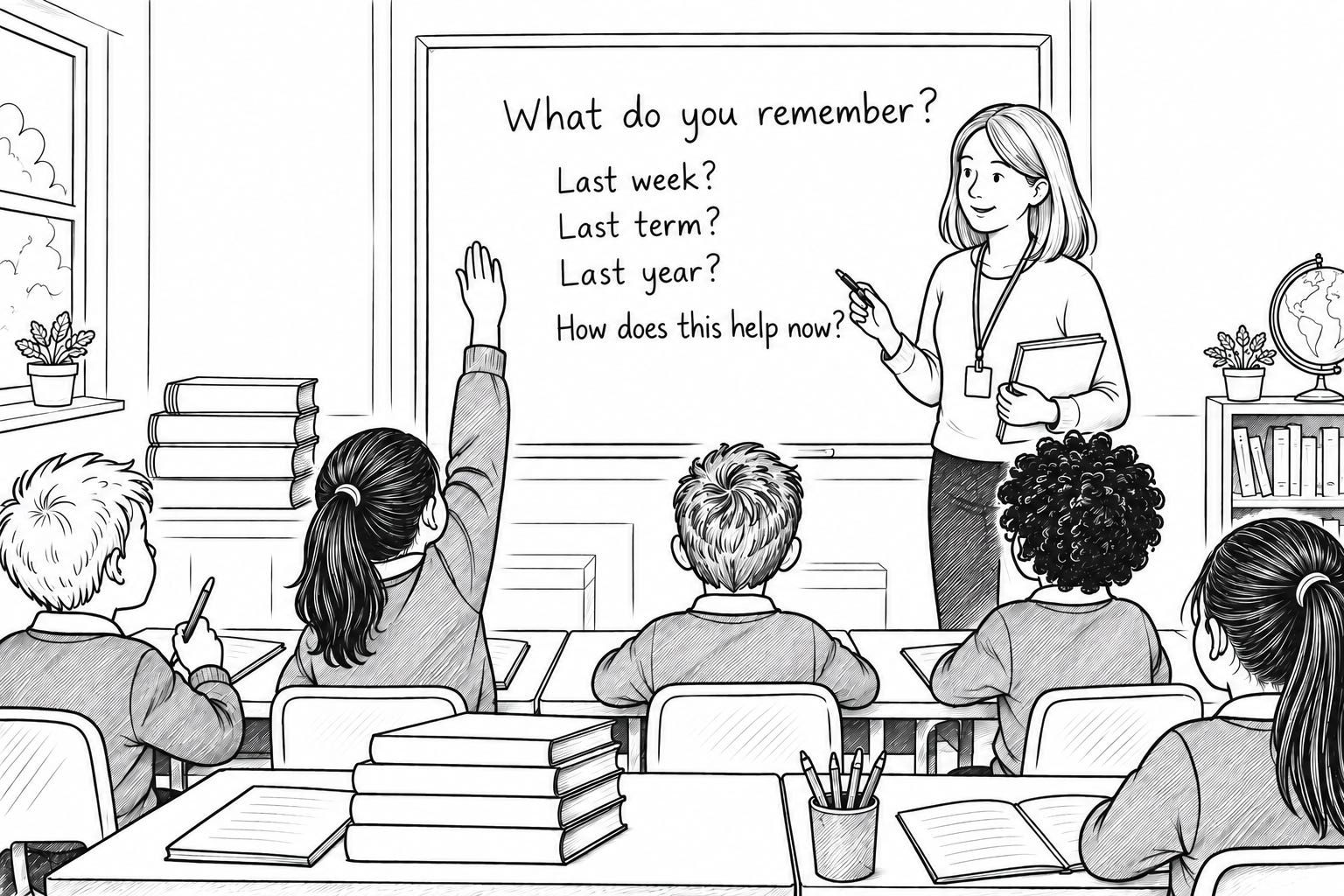

There has been a welcome and growing interest in how children learn, with research from cognitive science increasingly informing conversations about curriculum, teaching and classroom practice. This has given schools a much stronger language for thinking about learning and, importantly, encouraged us to examine some of the assumptions that have shaped practice over time. Alongside that discussion, I think there is value in returning regularly to a straightforward question: what do we know helps children learn, and are we doing those things well enough?
One useful answer comes from the work of John Dunlosky, Katherine Rawson, Elizabeth Marsh, Mitchell Nathan and Daniel Willingham, who reviewed ten commonly used learning techniques and considered their usefulness across different learners, materials and contexts. Two received the highest rating: practice testing and distributed practice. In the language we are more likely to use in schools, children benefit from retrieving what they have learned and from returning to it again over time. Neither is particularly new or complicated, and both will be familiar to primary teachers.
In a primary classroom, this can look very ordinary. Children might be asked to recall number facts they have learned previously, return to vocabulary during a reading lesson or complete arithmetic practice that includes content taught earlier in the year. These are familiar parts of teaching, but the research helps us to understand why they matter. Learning something successfully during a lesson is important, but we also want children to be able to remember and use that knowledge once the immediate support of the lesson has gone.
Remembering what has been taught
One of the challenges in judging learning is that children can appear to know something while the information is still readily available to them. Rereading a definition, looking again at a multiplication fact or following a worked example provides support that will not necessarily be there when the knowledge is needed later. Asking children to retrieve something from memory gives us a better indication of what they can recall independently, while the act of retrieval itself helps to strengthen that knowledge. Research into the testing effect has found that retrieving previously studied material can produce substantially better retention after a delay than simply studying the material again.
There is no particular classroom format required to make this happen. A short quiz might be useful, as might oral questioning, mini-whiteboards, flashcards or independent practice, with teachers choosing the approach that best fits the subject and what they want children to recall. The important feature is that children have regular opportunities to bring previously taught knowledge back to mind without always having the answer immediately available to them.
The review by Dunlosky, Rawson, Marsh, Nathan and Willingham is particularly interesting because several activities commonly associated with studying received much lower ratings. Rereading, highlighting and summarising were all judged to have relatively low utility. These activities may have a purpose in particular contexts, but the evidence does not support relying on them as effective ways of securing learning in memory. The useful point for primary schools is that children can spend a considerable amount of time working with material without necessarily making it easier to recall later. For pupils who are still developing their understanding of how to practise and learn effectively, that distinction is worth making explicit.
Coming back to things
The value of distributed practice will be familiar to anyone who has taught in a primary classroom because we see how easily learning that appeared secure can fade when children have not encountered it for some time. A class that was confident with fractions at the end of a unit may find the same content much harder several months later, and the same pattern can be seen across the curriculum as knowledge becomes less accessible without opportunities to use it. This is a normal part of learning, but it means that initial success cannot be our only measure of whether something has been learned securely.
Good teaching therefore needs to create opportunities for important knowledge to return. This does not necessarily require additional lessons or complicated systems, because previous learning can be incorporated into what children are already doing so that they continue to retrieve and use it after the original teaching has finished. Research into spacing has repeatedly demonstrated the importance of distributing encounters with material over time when the aim is longer-term retention. The precise approach will vary across subjects, but the underlying principle is straightforward: knowledge that we want children to retain needs to be revisited over time.
This has implications for curriculum planning because primary curriculum maps tend to be very clear about when something will first be taught, while what happens to that learning afterwards can receive less attention. If knowledge is important enough to teach, particularly where later learning depends upon it, we should also be thinking about when children will return to it and how we will know whether it has remained secure. Planning for learning over time requires us to expect some forgetting and to make deliberate opportunities for children to strengthen what they have previously learned.
Teaching children how to practise
There is also something important here about the way we teach children to practise, particularly in primary school when many of their habits as learners are still developing. We routinely ask children to practise, learn spellings or prepare for a test, but those instructions assume that children know what useful practice looks like. If some of the approaches that feel productive are less effective at securing knowledge over time, there is good reason to help children understand how they can practise more successfully.
Primary school gives us an opportunity to establish this understanding early, so that children become accustomed to trying to remember before looking at the answer and returning to important material after some time has passed. They can also begin to understand why something that was easy last week might feel harder today, and why having to think carefully to retrieve an answer can be a useful part of learning. Over time, this can help children develop a better understanding of what to do when they want something to stick.
Doing the basics well
The growing interest in retrieval practice and spacing has been valuable, but there is always a risk that a useful principle becomes too closely associated with a particular classroom routine. Retrieval practice can come to mean a five-question starter, for example, when the more useful question is whether children are regularly being asked to remember and use what they have previously learned. Looking beyond the format allows us to concentrate on the quality and purpose of the practice rather than whether a particular routine is visible in every classroom.
For primary school leaders, this raises a wider question about consistency. Children do not need every classroom to operate in exactly the same way, but their opportunities to practise and retain important knowledge should not depend entirely on the habits of the individual teacher they happen to have. A well-planned curriculum can help teachers see what children should already know, identify the knowledge that needs continued attention and make sensible connections between previous and current learning. Assessment can then help us understand what has remained secure and where children need further teaching or practice.
There will always be new ideas to consider, and the continuing discussion about how children learn should help us improve what happens in classrooms. At the same time, improvement can come from looking carefully at the everyday experience of children and asking whether the things we already know support learning are happening often enough and well enough. With so many ideas competing for the attention of schools, there is value in keeping sight of the fairly ordinary work of teaching important things well, giving children enough practice, returning to previous learning and noticing when something has not yet become secure. None of this is especially new, but doing the basics consistently well across a primary school remains a considerable achievement.
References
Cepeda, N. J., Vul, E., Rohrer, D., Wixted, J. T., & Pashler, H. (2008). Spacing effects in learning: A temporal ridgeline of optimal retention. Psychological Science, 19(11), 1095–1102.
Dunlosky, J., Rawson, K. A., Marsh, E. J., Nathan, M. J., & Willingham, D. T. (2013). Improving students’ learning with effective learning techniques: Promising directions from cognitive and educational psychology. Psychological Science in the Public Interest, 14(1), 4–58.
Roediger, H. L., III, & Karpicke, J. D. (2006). Test-enhanced learning: Taking memory tests improves long-term retention. Psychological Science, 17(3), 249–255.
Rosenshine, B. (2012). Principles of instruction: Research-based strategies that all teachers should know. American Educator, 36(1), 12–19, 39.