

Reliable Excellence explores an important question:
How do we ensure that every child experiences high-quality learning, every day?
A commitment to every child inevitably raises questions about expectations. If schools exist to help children learn, then every pupil should encounter ambitious learning experiences that extend their knowledge, develop their understanding and increase what they are able to do. Yet while most schools would readily agree with this principle, translating it into the daily experiences of every child is considerably more demanding.
High expectations are often discussed as a characteristic of individual teachers. Many people can recall a teacher who believed in them, challenged them and refused to accept less than their best. Such teachers can have a profound impact on pupils’ lives. However, if high expectations depend primarily upon individual commitment, then pupils’ experiences will inevitably vary from classroom to classroom. School leaders must therefore consider how high expectations can be embedded across the organisation.
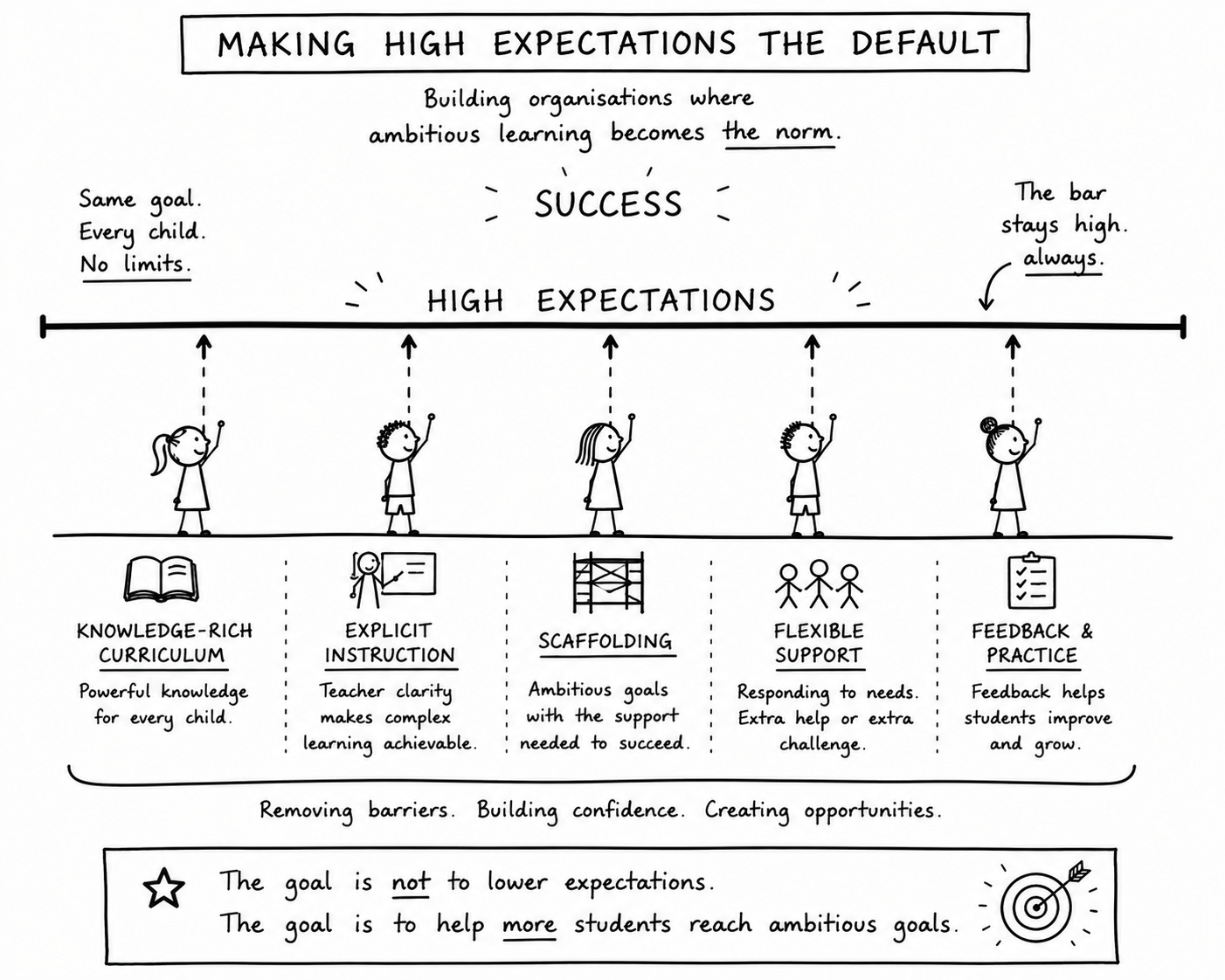
Expectations become visible through the opportunities pupils are given and the standards they are routinely asked to meet. If schools believe every child can succeed, then every child must be given access to challenging content, expert instruction and the support needed to succeed with demanding work. High expectations are reflected in the decisions schools make about curriculum, teaching, assessment and the wider learning environment. The ways in which schools can communicate high expectations are almost limitless. What matters is that organisational decisions consistently reinforce the belief that every child can succeed. Examples might include:
A knowledge-rich curriculum that reflects a belief that every child is entitled to access powerful knowledge. It begins from the premise that all children can learn more than they currently know and the role of the school is to make that learning accessible.
Frequent use of explicit instruction that makes complex learning achievable. By carefully modelling new ideas, checking understanding and guiding practice, teachers reduce unnecessary barriers that might otherwise prevent pupils from succeeding.
Effective scaffolding which sets ambitious goals while temporarily providing the structures pupils need to be successful. As knowledge and confidence grow, those supports can gradually be removed. The destination remains unchanged even when the route varies.
Flexible groupings that respond to pupils’ current needs by providing additional support or challenge without placing limits on future learning.
Regular opportunities for feedback and deliberate practice that helps pupils refine their understanding and improve the quality of their work. High expectations are communicated when pupils are expected to revisit, improve and strengthen their learning rather than simply complete tasks and move on.
All these types of decisions increase the likelihood of ambitious learning for every child and promote equity. Schools serve pupils with different starting points, experiences and needs. Genuine equity requires those realities to be understood and addressed. Yet understanding barriers should lead to greater support, not lower expectations. The goal is not to make learning easier, but to make success attainable.
Creating an environment of high expectations requires leaders to ensure that curriculum, teaching, assessment, professional learning and school routines consistently reinforce ambitious learning. When high expectations depend on individuals, pupils’ experiences inevitably vary. However when they are embedded within everyday practice, more pupils encounter the challenge, support and opportunities needed for successful learning.
References
Bambrick-Santoyo, P. (2018). Leverage Leadership 2.0: A Practical Guide to Building Exceptional Schools.
Dweck, C. (2006). Mindset: The New Psychology of Success.
Rosenshine, B. (2012). Principles of Instruction: Research-Based Strategies That All Teachers Should Know. American Educator, 36(1), 12–19.
Get in touch - lois@reliable-excellence.com
Great blog Lois. Consistent, coherent, consequence systems, which always focus on high expectations.