


We think carefully about inclusion for children, but the workplace adults experience every day may be one of the strongest models we have for what inclusion actually looks like.
For school leaders, inclusion is usually discussed with children at the forefront of our minds. We think about who is participating, who is succeeding, who feels they belong and what might prevent some children from accessing the same opportunities as others. We consider reasonable adjustments, additional support, curriculum access, relationships and the conditions individual children may need in order to flourish. Yet some of the most revealing evidence about a school’s approach to inclusion can be found before we ever enter a classroom. It is in the workplace we have created for the adults.
The organisational experience of adults is easy to overlook, yet it provides the backdrop to the decisions they make for children every day. Staff experience how information is shared, how opportunities are distributed, how individual circumstances are accommodated, how performance is managed and how much flexibility exists when life does not fit neatly around work. They also experience the less formal parts of organisational life: who is known, who is trusted, who gets asked, who gets encouraged and whose circumstances are understood.
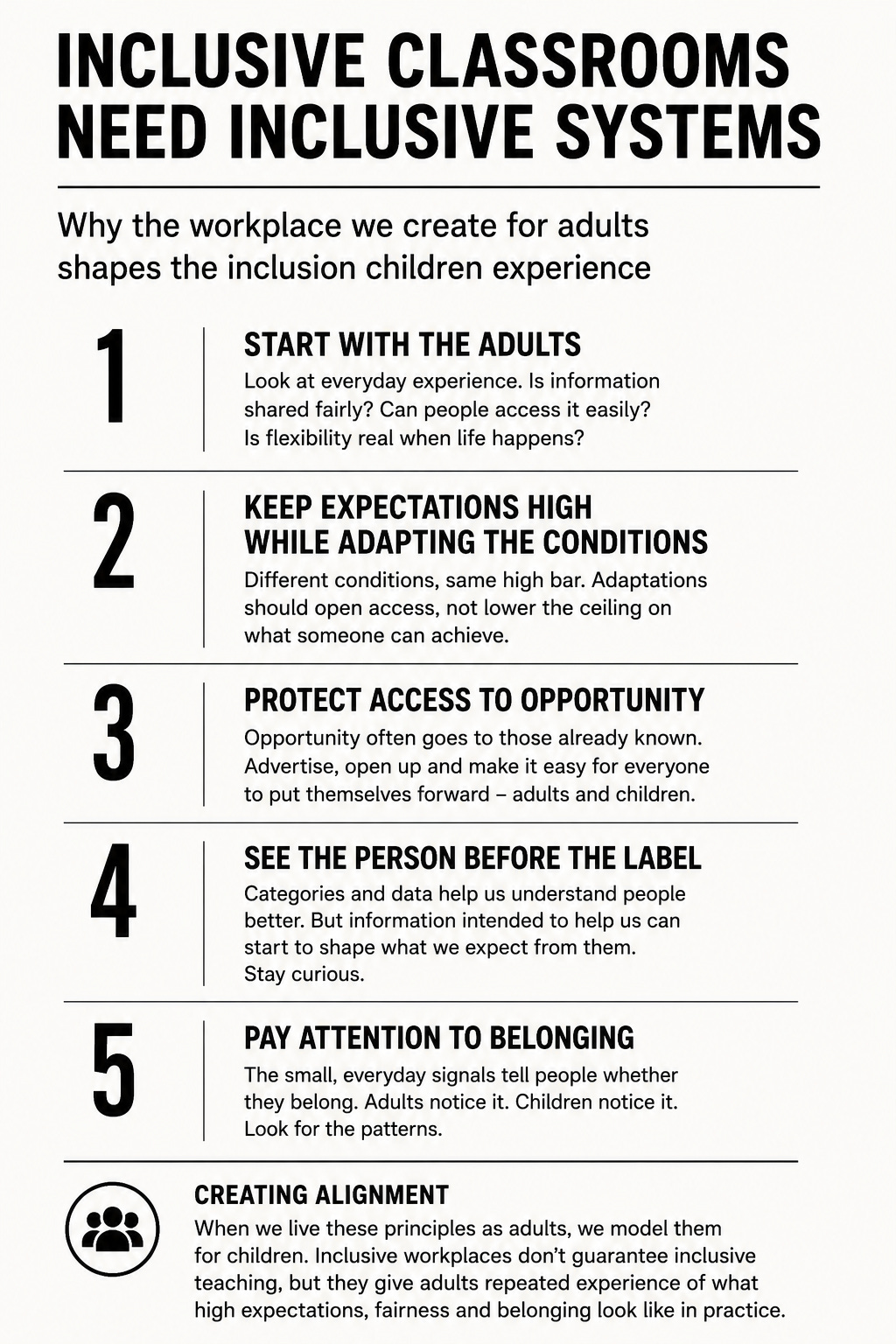
Looking at the workplace gives school leaders another way into inclusion. Alongside examining what happens for children, we can ask whether the adults around them experience the same principles in practice. There are five areas in particular that are worth examining:
1. Start with the adults
The everyday experience of coming to work can tell us far more about inclusion than a policy alone. A school may have an excellent flexible-working policy, but the more revealing moment comes when someone’s child is ill and they need to leave unexpectedly. How easy is it to say so, and can the organisation respond with flexibility and common sense without that person feeling their commitment has somehow been called into question?
Access to information provides another very ordinary example. A Friday briefing might work perfectly well for most staff, while somebody who does not work on Fridays repeatedly arrives on Monday without information their colleagues already have. The solution does not need to be sophisticated: an email, a shared document or a whiteboard in the staffroom might be enough. The important thing is noticing that a routine designed around the majority has made participation harder for somebody else.
Small things like these tell us a great deal about an organisation. Who has to work harder to access the same information? Who regularly has to ask for something everybody else receives automatically? Whose circumstances fit comfortably within the way the school operates, and whose require constant negotiation?
2. Keep expectations high while adapting the conditions
Most good workplaces already accept that people sometimes need different conditions in order to do excellent work. A member of staff may need a reasonable adjustment because of disability, flexibility around caring responsibilities, information presented in a more accessible way or additional support while learning something unfamiliar. We can accommodate those things without making a judgement about that person’s intelligence, ambition or professional potential.
The same principle applies to children. Adaptation should give a child better access to learning without quietly changing our view of what they might ultimately be capable of. Some children will need more scaffolding, different resources, additional explanation, more practice or changes to their environment. Others will need substantially different provision. The support required at a particular point in time should not become a ceiling on what we think might be possible later.
Adults who experience this in their own workplace know that fairness does not always mean treating everybody identically. They also know what it feels like when somebody responds to what they need now without making assumptions about what they might be capable of next.
3. Protect access to opportunity
Some of the biggest differences in people’s working lives begin with opportunities that do not make it to an advert. A project comes up and somebody immediately springs to mind. A senior leader recommends someone they have worked with before. An interesting piece of work goes to the person who has done something similar. Someone mentions that they would like to progress and starts receiving experiences that will eventually make them a stronger candidate for promotion.
Much of this feels perfectly reasonable while it is happening. The problem comes when opportunity repeatedly travels through the same relationships. Over time, who is known, trusted, recommended, encouraged or invited into the room shapes who gets access to opportunity. People who receive those opportunities become more experienced and more visible, making them more likely to come to mind the next time something comes along.
Leaders can interrupt some of this quite easily. Advertise roles rather than just allocating them. Run a proper recruitment process rather than relying on who somebody knows. Offer development opportunities widely enough for people to put themselves forward, including those we had not imagined would be interested. There will always be times when approaching someone directly makes sense, but it is worth noticing whose names repeatedly come to mind and whose rarely do.
There is a version of this for children too. A child who needs additional teaching may have to miss something else to receive it, and sometimes that decision will be entirely sensible. It is the cumulative effect that deserves attention. If a child who is behind in literacy or mathematics repeatedly misses science, art, music, sport or humanities to catch up, support intended to help them can gradually leave them with a narrower education than their peers. We should know what children are gaining from additional provision, but we should also know what they are giving up to receive it.
4. See the person before the label
Categories and data can reveal differences that might otherwise be easy to miss. They can show us, for example, whether attendance, attainment, participation or access to opportunity looks different for particular groups, and help us understand where additional support may be needed. The difficulty is that information gathered to help us understand somebody can also influence what we come to expect from them, particularly when a diagnosis, previous outcome or personal circumstance starts to stand in for everything else we know about that person.
We would be wary of doing this to adults. Someone may work part time, need a reasonable adjustment, have significant caring responsibilities or go through a period when their performance is not where it needs to be. Those things may be relevant to decisions we make, but we would not want them to become that person’s professional identity or to determine indefinitely which opportunities they are offered. Fair processes help here too. Decisions about performance, development and progression should draw on good evidence and, where appropriate, more than one perspective, so that an established view of somebody does not become impossible to shift.
The same care is needed with children. A diagnosis can help us understand the support a child may need without telling us everything about them. Prior attainment tells us something about what they know now, not what they will ultimately be capable of learning. Behaviour gives us information that may need to be understood and acted upon, without becoming the way a child is known. The more information we gather about children, the more important it is to use it to understand them better rather than to narrow what we imagine might be possible for them.
5. Pay attention to belonging
Belonging can be difficult to pin down, but much of it is built through very ordinary experiences of being part of an organisation. Adults notice whether they receive the information everybody else receives, whether their contribution is taken seriously and whether anyone thinks of them when an opportunity comes up. They notice whether flexibility is genuinely available or depends on which manager they happen to have, whether they can disagree without damaging a relationship and whether working part time gradually moves them towards the edge of organisational life.
Children notice their own versions of these things throughout the school day. They know who is trusted with responsibility, whose answers adults seek, who gets chosen, whose success is noticed and who spends significant amounts of time somewhere other than the classroom. They know whether adults seem pleased to see them, whether they are expected to contribute and whether getting something wrong changes the way people respond to them.
Each individual moment may have a perfectly reasonable explanation. A missed briefing, an invitation that never comes, an assumption about somebody’s availability or a child repeatedly leaving the classroom for intervention can all seem insignificant on their own. Look across them, though, and patterns begin to emerge about who is consistently at the centre of organisational life and who spends more time at its edges.
Creating alignment
There are obvious limits to any comparison between the experience of employees and children, and schools have responsibilities towards pupils that are different from those they hold towards their workforce. The value lies in whether there is alignment in the principles underneath both. A strong belief in adaptation for children should be reflected in the way we respond to the different needs of adults, just as concern about children’s access to opportunity should make us attentive to how opportunity travels through the workforce. Asking teachers to look beyond labels also requires us to consider the reputations and assumptions that can attach themselves to staff. And if belonging is important for children, we should be interested in whether the adults around them feel valued, included and fully part of the organisation.
There is something powerful about experiencing these things rather than only being trained to provide them. A teacher whose manager responds sensibly when something unexpected happens at home knows what flexibility without lowered expectations feels like. A member of staff who is encouraged to put themselves forward for something they had assumed was beyond them knows the difference an invitation can make. A part-time colleague who does not have to chase information from meetings held on their day off knows the difference between technically having access and actually having it.
The culture adults experience does not stay neatly in the staffroom. It travels into classrooms, conversations with families and the many small decisions people make about children. An inclusive workplace cannot guarantee inclusive teaching, but it gives adults repeated experience of what thoughtful adaptation, fair access to opportunity, high expectations and belonging look like in practice.
We ask adults to build classrooms in which children are known well, supported when they need it, given access to opportunity and never written off because of a label or a difficult period. The organisation around those classrooms should give them some idea of what that feels like.
References
Acas (2025). Reasonable adjustments at work. Acas. Reasonable adjustments at work
Chartered Institute of Personnel and Development (CIPD) (2021). Race inclusion reports: Ensuring equality of career progression opportunities. CIPD. Ensuring equality of career progression opportunities
Chartered Institute of Personnel and Development (CIPD) (2022). Inclusion at work 2022. CIPD. This is particularly relevant to your argument about examining people-management systems, leadership and access to opportunity through an inclusion lens. Inclusion at work 2022
Education Endowment Foundation (EEF) (2020). Special Educational Needs in Mainstream Schools. EEF. Particularly useful for your sections on maintaining high expectations, adapting provision and supporting pupils with SEND to participate and succeed. Special Educational Needs in Mainstream Schools