


Reliable Excellence explores an important question:
How do we ensure that every child experiences high-quality learning, every day?
Research has significantly improved our understanding of teaching and learning. Schools now have access to a substantial body of evidence about curriculum design, explicit instruction, assessment, feedback and practice. Across many education systems there is far greater agreement about effective teaching than there was twenty years ago, yet improvements in classroom practice often happen more slowly than expected.
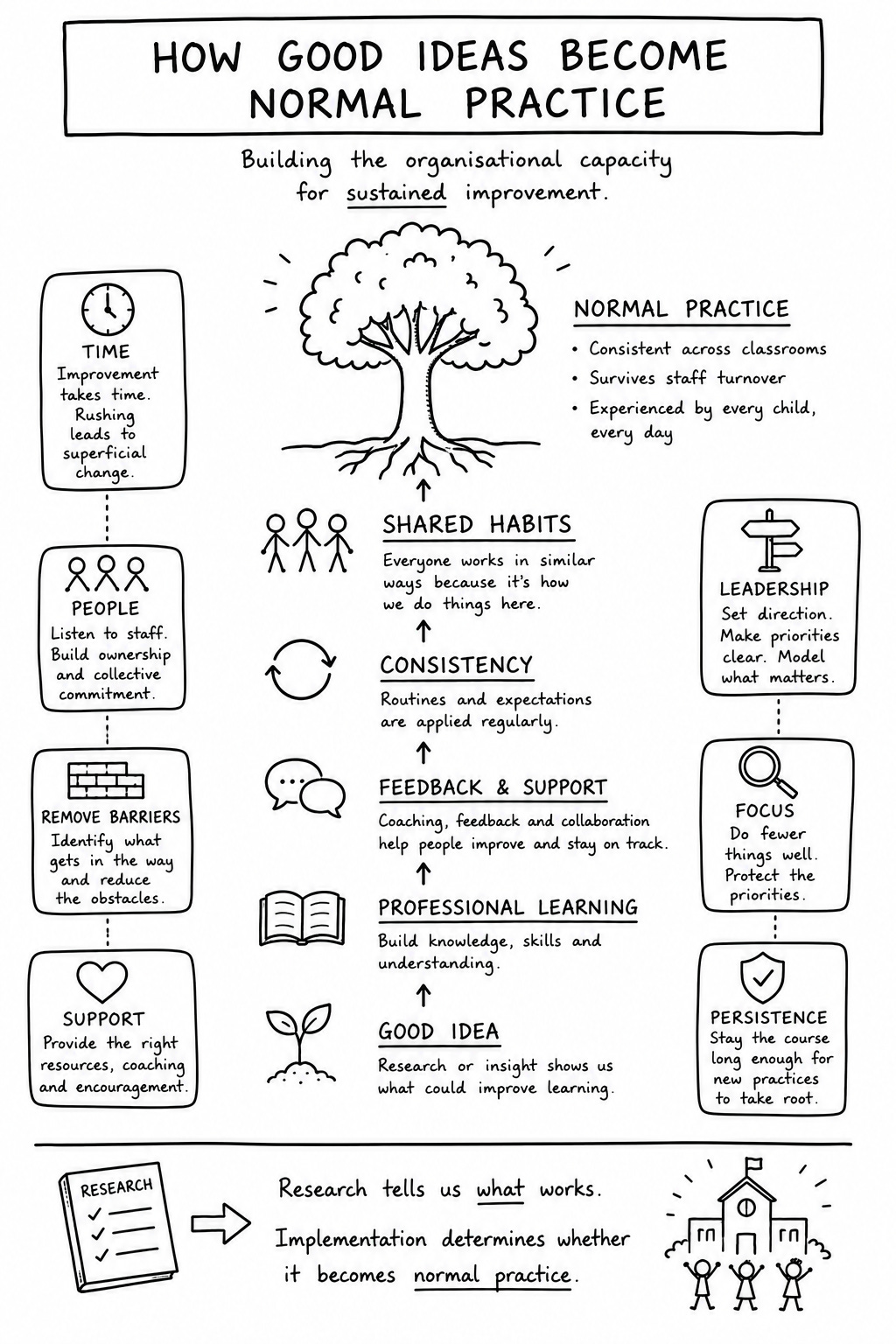
Part of the explanation lies in the difference between understanding an idea and embedding it across an organisation. A school may recognise the value of a knowledge-rich curriculum or understand the principles of effective instruction, but turning that understanding into consistent practice across dozens of classrooms requires sustained effort over time. The work extends well beyond selecting an approach. Staff need opportunities to develop expertise, leaders need to provide support and feedback, curriculum materials often need refining and professional learning needs to reinforce the intended direction. Each element depends upon leadership attention and organisational capacity.
This is a reality that can sometimes be overlooked in discussions about school improvement. Research tells us a great deal about what is likely to improve outcomes for children, but schools operate within environments where improvement competes with many other demands. Leaders are balancing staffing pressures, attendance concerns, wellbeing, behaviour, parental expectations, budgets and compliance requirements alongside their ambition to improve teaching and learning. Every improvement priority draws upon the same finite resources of time, expertise and attention.
The schools that make sustained progress are rarely those attempting to implement the greatest number of initiatives. More often, they have developed clarity about what matters most and have created the conditions for that work to become embedded over time. Leaders understand the current reality of the organisation, listen carefully to staff, identify barriers and focus their efforts on a manageable number of priorities. Improvement gathers momentum because people have sufficient time to develop confidence and competence before attention shifts elsewhere.
Staff turnover adds a further layer of complexity. Schools are constantly welcoming new colleagues whilst supporting others into different roles or organisations. This means improvement cannot rely upon individual enthusiasts carrying a particular approach. Effective practice needs to become part of the organisation itself. New staff should encounter established routines, clear expectations and shared ways of working that help them contribute quickly and effectively. Over time, the organisation becomes increasingly capable of sustaining its direction despite inevitable changes in staffing.
For this reason, leadership is closely connected to implementation. School improvement depends upon a leader’s ability to translate ideas into systems, routines and habits that influence daily practice. This involves understanding how change happens, where resistance is likely to emerge and what support people need in order to develop new ways of working. Successful implementation is usually characterised by consistency, persistence and a willingness to remain focused long enough for new practices to become established.
Many schools already know a great deal about effective teaching and learning. The question is how that knowledge becomes part of everyday practice. Creating the organisational capacity to make good ideas stick may be one of the most significant responsibilities of school leadership. When effective approaches become embedded within the organisation itself, they become more reliable, more sustainable and more likely to be experienced by every child, every day.
References
Bambrick-Santoyo, P. (2018). Leverage Leadership 2.0: A Practical Guide to Building Exceptional Schools. Jossey-Bass.
Fixsen, D. L., Naoom, S. F., Blase, K. A., Friedman, R. M. & Wallace, F. (2005). Implementation Research: A Synthesis of the Literature. University of South Florida.
Fullan, M. (2020). Leading in a Culture of Change (2nd ed.). Jossey-Bass.
Kotter, J. P. (2012). Leading Change. Harvard Business Review Press.