

Reliable Excellence explores one important question:
How do we ensure that every child experiences high-quality learning, every day?
For many years, I thought I had a reasonably good answer. I had trained as a teacher, progressed into leadership and spent much of my time observing lessons, coaching colleagues and thinking about how schools improve. Around that time, I began encountering writing and research that challenged some of the assumptions I had absorbed during my own training and early career. It introduced me to a body of knowledge about memory, cognitive load and learning that I had barely encountered before.
I remember talking to a close friend about it. We had trained together and, by that point, both held roles that involved observing lessons, coaching teachers and providing feedback on teaching and learning every day. We admitted something to one another that felt deeply uncomfortable. We had both been teaching for around five years before we had seriously engaged with research around memory, cognitive load and learning. The conversation makes me smile now, although at the time we were mortified. Here we were, helping other teachers improve their practice, yet neither of us had spent much time thinking about how learning actually happens.
Our experience was far from unusual. Teacher training looked different. We learned about planning, assessment, behaviour management and curriculum design. We explored approaches that sought to engage children through inquiry, discovery and authentic experiences. Mantle of the Expert, project-based learning and inquiry-led approaches were exciting and intellectually stimulating. They encouraged creativity, collaboration and deep engagement with ideas. Many of us embraced them because we cared deeply about children’s learning and wanted school to be meaningful and inspiring. What was often missing was a clear understanding of how memory works and the implications this has for teaching. The science of learning was not absent because teachers were uninterested in evidence. In many cases, it simply was not part of the professional conversation in the way it is today.
My friend and I reached a straightforward conclusion - we urgently needed to learn more.
Over the years since, I have had versions of that same conversation with teachers, middle leaders, principals, trust leaders and system leaders. Many have described the moment they first encountered the science of learning as both exciting and unsettling. It offered a compelling explanation of how learning happens, while also challenging assumptions they had held for years and raising difficult questions about practice.
What has become increasingly clear to me is that this experience is not unique to the science of learning. Throughout my career I have found myself leading work in areas where I was still developing my own understanding. I experienced it when moving from teaching Year 6 to leading the implementation of systematic synthetic phonics; when preparing schools for new Ofsted and SIAMS inspection frameworks and my favourite example came much later during the national conversation in England about reinforced autoclaved aerated concrete (RAAC). Suddenly, school leaders across the country found themselves staring at photographs, ceiling panels and building plans, attempting to determine whether their buildings contained a material that very few had heard of only months earlier. My point is that leadership rarely requires us to know everything in advance. More often, it requires us to learn quickly, seek expertise and help others make sense of change.
As my understanding of the science of learning developed, I began to think differently about knowledge. The relationship between curriculum, memory and learning became clearer, and ideas I had previously considered separately started to fit together more coherently. I became increasingly focused on what children were learning, how that learning was secured over time and how schools could support that process. This also led me to consider the wider purpose of knowledge. If knowledge is central to education, it should do more than enable children to perform well in assessments. It should help them make sense of the world, participate fully within it and develop the understanding, confidence and agency to lead rich and meaningful lives.
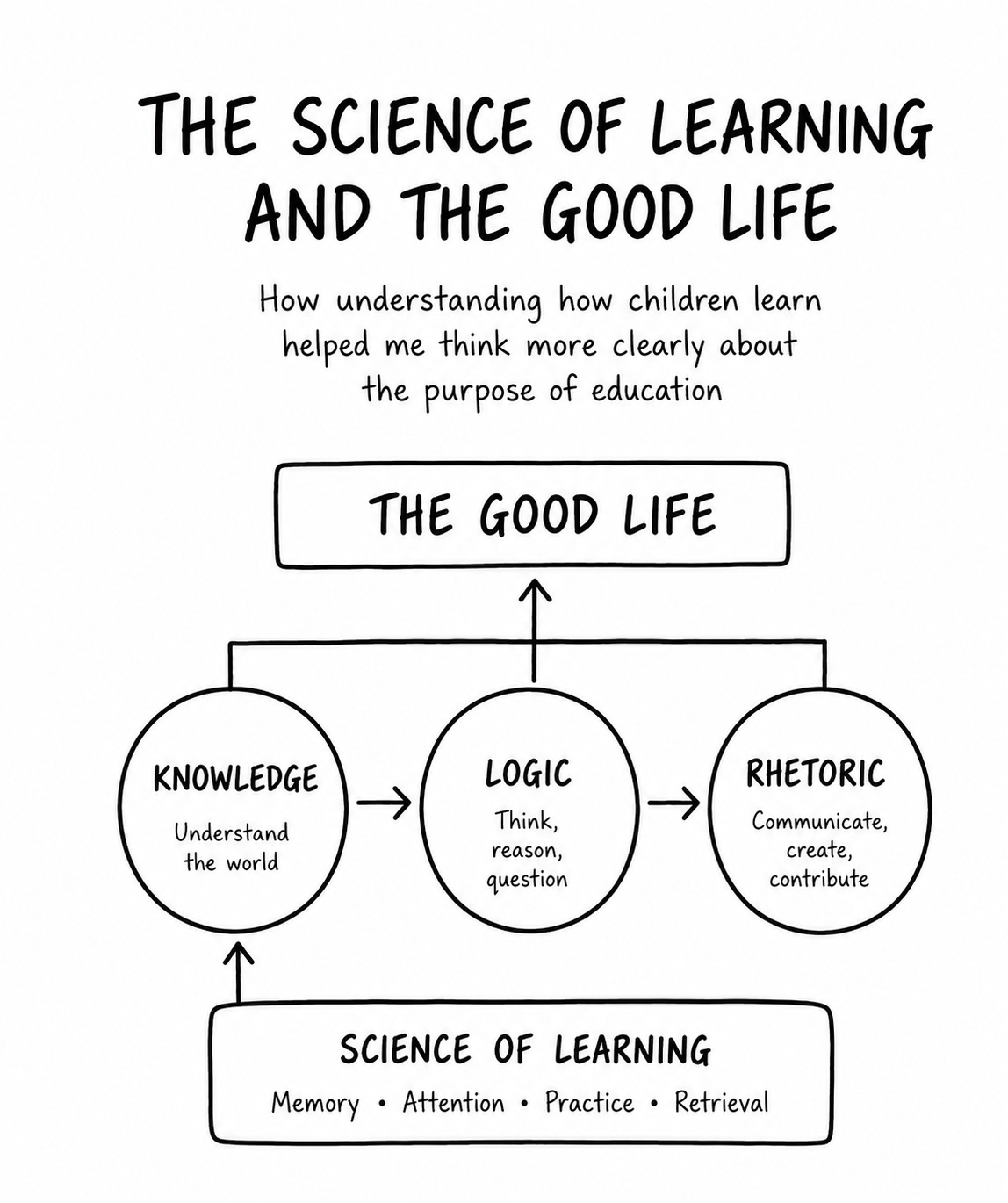
Around the same time that I was exploring the science of learning, I was introduced to Martin Robinson’s Trivium 21c. Initially, I struggled with it. A year or so later, after the birth of my first daughter, I picked it up again and found myself drawn to a section called The Good Life. Robinson reflects on what he wants for his daughter. He wants her to know things and be able to do things. He wants her to question, explore and make sense of the world. He wants her to communicate what she has learned, discovered and created. Ultimately, he wants her to live a good life. It felt like a powerful articulation of what many of us hope education might help young people achieve.
The Trivium has its roots in classical education and centres on three interconnected ideas: knowledge, logic and rhetoric. Knowledge provides the foundation. Logic enables young people to think with and about that knowledge. Rhetoric enables them to communicate, persuade, create and contribute. What appealed to me was the clarity it brought to the purpose of education. Schools are places where young people develop the knowledge, understanding and capability required to participate fully in the world around them.
The science of learning and the Trivium helped me answer different questions. The science of learning helps us understand how children acquire, retain and retrieve knowledge. It explains why curriculum, memory, practice and feedback matter. The Trivium asks what that knowledge is ultimately for. It reminds us that education should equip young people to think critically, engage thoughtfully with ideas and contribute meaningfully to society.
This distinction helped me reconcile what can sometimes appear to be competing educational narratives. A knowledge-rich curriculum, retrieval practice, explicit teaching and carefully sequenced learning are not a narrower vision for children. They are ways of helping more children acquire the knowledge that enables them to reason, communicate and participate fully. Performance, sport, debate, creativity, leadership, enrichment and service are not separate from that work. They are opportunities for children to apply, refine and communicate what they know.
I saw this most clearly when I took over a school with a relatively affluent intake that was achieving less well than schools serving communities with greater levels of disadvantage. The school had many strengths. Children were happy, families were supportive and staff cared deeply about the school. However, its approach to teaching and learning had not kept pace with developments in research about how children learn, and outcomes did not reflect either the potential of the children or the ambition of the community.
Our starting point was not to discard what was already in place. We began with an honest conversation about teaching and learning. Staff considered where they saw themselves on a broad pedagogical spectrum, from more inquiry-led and student-directed approaches to more teacher-directed approaches. We discussed the expectations against which the school would be held accountable, including national assessment and inspection, but we also discussed a larger question:
What education did we want to provide for our children?
The Good Life gave us a useful way of holding that conversation. We wanted children to acquire secure knowledge, but we also wanted them to reason, question, communicate, create and contribute. The science of learning did not sit apart from that vision. It helped us strengthen the foundations on which it depended.
The work developed through professional learning, coaching, peer observation and regular conversations about classroom practice. Some teachers had already taught themselves a great deal about the science of learning, and they opened their classrooms to colleagues. Teachers observed whole-class reading taught through direct instruction, alongside practical strategies such as checking for understanding, retrieval practice and deliberate practice. These approaches became visible through observation, coaching and discussion, allowing colleagues to see them in use and adapt them thoughtfully within their own classrooms.
We began using knowledge-rich curriculum materials, initially drawing on high-quality existing resources and then refining them as our understanding and confidence grew. We implemented systematic synthetic phonics at pace because we judged it too important to delay. We developed a shared set of teaching principles, informed by Rosenshine’s work, which staff could draw upon when planning and teaching. These were not intended as a checklist to be applied mechanically in every lesson. Instead, they gave teachers a practical toolbox for making informed decisions about explanation, modelling, questioning, checking for understanding, practice and review. We also reviewed intervention so that it was more sharply focused on the knowledge pupils needed to secure, and used flexible groupings where they were useful while retaining high expectations for every child. The aim was to develop greater consistency in the conditions that enable children to learn well, while retaining professional judgement about how those conditions were created.
Within a year, 95% of our Year 1 pupils passed the phonics screening check, representing a substantial improvement on the school’s previous outcomes and placing results significantly above the national average. Pupil outcomes at the end of Year 6 in reading, writing and mathematics were also significantly above average. This academic progress was accompanied by a strong and positive staff culture. Staff wellbeing survey results were high, and an Ofsted inspector commented on the happiness and positivity of the team. We also broadened pupils’ opportunities beyond the core curriculum. Participation in visual art increased, with work showcasing a clear progression of knowledge. This provided a foundation for expanding our service and charitable work, including courageous advocacy rooted in the school’s Christian vision. Alongside this, the school continued to achieve success in sport, winning a number of awards and trophies.
Strengthening teaching through the science of learning had not required the school to become narrower or less distinctive. It enabled us to pursue our vision with greater clarity. Children were learning more securely while continuing to experience a rich education that included performance, sport, creativity, service, contribution and more.
Although the school served a relatively affluent community, around 12 per cent of pupils were disadvantaged. This made the work particularly important. Talent is distributed widely, but opportunity is not. Every child deserves access to powerful knowledge, teaching that enables them to learn it successfully, and opportunities to use that knowledge in meaningful ways. For children who may have fewer opportunities to acquire this knowledge beyond school, the quality and reliability of classroom teaching matters even more. The science of learning can help schools make that entitlement more dependable.
When I look back now, I do not think the school was failing before this work began. Children were safe and happy, staff were committed, and there was much to value. The work was about becoming more deliberate: understanding learning more deeply, strengthening practice and ensuring that the daily experience of children matched the school’s ambitions for them.
The question that continues to drive my thinking is the same one that sits at the heart of Reliable Excellence: how do we ensure that every child experiences high-quality learning, every day? The science of learning has become an important part of my answer because it helps schools strengthen the core purpose that sits beneath every wider aspiration: enabling children to learn securely, use what they know and lead fulfilling, meaningful lives.
Get in touch - lois@reliable-excellence.com
References
Bjork, R. A., & Bjork, E. L. (2020). Desirable Difficulties in Theory and Practice.
Christodoulou, D. (2014). Seven Myths About Education. Routledge.
Kirschner, P. A., Sweller, J., & Clark, R. E. (2006). “Why Minimal Guidance During Instruction Does Not Work: An Analysis of the Failure of Constructivist, Discovery, Problem-Based, Experiential, and Inquiry-Based Teaching.” Educational Psychologist, 41(2), 75–86.
Robinson, M. (2013). Trivium 21c: Preparing Young People for the Future with Lessons from the Past. Crown House Publishing.
Rosenshine, B. (2012). “Principles of Instruction: Research-Based Strategies That All Teachers Should Know.” American Educator, 36(1), 12–19.
Willingham, D. T. (2009). Why Don’t Students Like School? A Cognitive Scientist Answers Questions About How the Mind Works and What It Means for the Classroom. Jossey-Bass.