


Reliable Excellence explores an important question:
How do we ensure that every child experiences high-quality learning, every day?
In Australia, schools are increasingly being asked to become evidence-informed. National and state bodies are producing guidance on effective teaching, curriculum, assessment and implementation, while policy conversations place greater emphasis on using research and data to improve outcomes for students.
This is a positive development. Evidence can help leaders and teachers move beyond preference, habit and ideology. It can provide a stronger foundation for decisions about curriculum, assessment, teaching, behaviour and professional learning, and help schools focus more clearly on the practices most likely to improve learning.
However, access to evidence does not automatically lead to better experiences for students. A school may know a great deal about cognitive load, retrieval practice, explicit instruction, formative assessment or implementation science, yet still struggle to translate that knowledge into consistent classroom practice. Teachers may attend high-quality professional learning, agree with the principles being presented and return to classrooms where little changes.
If every child is to experience high-quality learning every day, schools need more than access to research or a collection of evidence-based strategies. They need leaders who can create the organisational conditions in which teachers are able to understand, apply and refine evidence-informed practice over time.
Evidence does not improve schools by itself. Improvement happens when leaders create the conditions in which evidence can shape everyday practice.
The leadership work of translation
The starting point for evidence-informed improvement is not the search for a new strategy. It is a worthwhile problem.
Schools are often drawn towards broad ambitions such as raising standards, improving engagement or strengthening teaching. These ambitions are understandable, but they are rarely precise enough to guide improvement. Leaders need to understand where students are struggling, what they are not yet understanding, which groups are being underserved and what patterns are visible in assessment, attendance, behaviour, curriculum access or classroom practice.
A school may decide that it wants to improve literacy, for example. That can quickly lead to a long list of possible interventions. A more useful starting point might be the recognition that students are struggling to write extended analytical responses, that their vocabulary is limited in particular subjects, or that the curriculum does not provide sufficient opportunities to practise writing in a structured way. The more clearly a school understands the problem, the more carefully it can consider what evidence is relevant and what response is likely to be worthwhile.
Research does not remove professional judgement; it gives that judgement a stronger foundation. Evidence can indicate what is likely to be effective, for whom and under what conditions, but it cannot prescribe exactly what a particular school should do with its own students, staff, curriculum and constraints. Leaders need to interpret the evidence in the light of the problem they are trying to solve, the knowledge and confidence of their staff, and the practical conditions required for change to succeed.
This is also where schools need to avoid turning evidence into compliance. Teachers may be asked to use retrieval practice, cold call, worked examples, mini-whiteboards or explicit instruction because these approaches are associated with evidence-informed practice. Each can be valuable, but none is valuable simply because it is visible. Their value lies in the learning purpose they serve.
When teachers are expected to reproduce techniques without understanding the principles behind them, schools can achieve surface consistency without improving professional judgement. Staff may use the language of evidence-informed practice while remaining unsure about why a strategy is useful, when it should be used or how it should be adapted for different content and learners.
Professional learning needs to build understanding as well as establish shared practice. Teachers should have opportunities to explore why reducing cognitive load matters, when modelling is most useful, what makes practice effective, how feedback can support learning and why checking for understanding should shape subsequent teaching. The aim is to develop teachers who understand learning well enough to make thoughtful instructional decisions within a coherent school approach.
Creating the conditions for practice to change
Schools are busy organisations. Leaders are responsible for attendance, behaviour, safeguarding, curriculum, assessment, wellbeing, staffing, parental communication and financial stewardship, alongside the daily work of supporting students and staff. In this environment, improvement can become fragmented when every worthwhile idea is treated as equally urgent.
Leaders need to decide what deserves focused attention now, what can wait and what should stop. This is not a matter of lowering ambition. It is a recognition that improvement requires time, attention and repetition. When schools attempt to implement too many changes at once, staff become overwhelmed and leaders lose the ability to see which changes are making a difference.
A small number of coherent priorities allows a school to work with greater depth. It enables professional learning, coaching, curriculum development, assessment and quality assurance to reinforce the same shared focus. Teachers are more likely to see how different elements of school life connect, rather than experiencing each new initiative as an additional demand.
If a school is seeking to improve students’ writing, for example, leaders may decide that students need more explicit modelling, more structured opportunities to practise and more consistent feedback on sentence construction and paragraph development. That decision should then shape the work of the organisation. Teachers need time to examine examples, adapt curriculum materials and rehearse new approaches. Middle leaders need to know what to discuss with teams. Coaching needs to focus on the agreed priority. Assessment needs to provide useful information about whether students’ writing is improving. Quality assurance needs to help leaders understand whether the intended changes are reaching classrooms.
A single training session cannot carry this work. Improvement becomes more reliable when the routines and systems around teachers make the desired practice clearer, more manageable and more likely to endure. The task of leadership is to ensure that the school’s structures support the practice it says it values.
Inquiry, evaluation and adaptation
Evidence-informed improvement should not be a rigid process in which schools simply adopt a programme and wait for results. It should also not become an entirely local exercise in which teachers experiment without drawing on what is already known. Evidence-informed inquiry offers a more useful approach.
In an evidence-informed inquiry, leaders and teachers begin with a clearly defined problem, engage with relevant research, select a promising response and study what happens when it is applied in their own context. The question is not ‘What would we like to try?’ but ‘Given what we know from research, and what we know about our students, what is the most promising change we can make and how will we know whether it is working?’
This approach encourages teachers to think carefully about the relationship between evidence, practice and learning. It also helps leaders see implementation as a process of learning, refinement and adaptation rather than a simple exercise in delivery. Schools do not need to wait until every detail is perfect before beginning, but they do need to create regular opportunities to review what is happening and respond thoughtfully to what they find.
Monitoring impact is part of this work. It should not mean collecting endless data or mistaking activity for improvement. Leaders need to establish whether the intended change is reaching classrooms, whether teachers understand and are using the practice well, whether students are experiencing something different and whether their learning is improving as a result.
No single source of evidence provides a complete answer. Student work, assessment information, classroom visits, teacher feedback, student voice, curriculum review and professional discussion can each provide part of the picture. Taken together, they help leaders understand whether implementation is becoming embedded or whether it remains superficial. They also make it possible to adapt with purpose. If teachers understand an approach but struggle to use it within an existing curriculum, the issue may be with resources or planning rather than commitment. If practice appears consistent but students are not making stronger progress, leaders may need to revisit their understanding of the problem or the evidence informing their response.
What leadership development should provide
Australia is developing a stronger policy environment around evidence-informed practice. National and state organisations are producing useful evidence summaries, guidance and resources, while schools are increasingly expected to use research and data to inform improvement work. The missing link is often the leadership bridge between evidence and enactment: the practical capability required to turn evidence into coherent priorities, shared understanding, consistent practice and sustained improvement.
Principals, deputies and middle leaders need development that helps them lead this work in their own settings. Such a programme would help leaders identify a worthwhile learning problem, interpret evidence without becoming compliance-driven and turn that evidence into a small number of coherent school priorities. It would support them to build teacher understanding rather than technique compliance, and to use coaching, routines, curriculum, assessment and quality assurance to embed change.
It would also give leaders a structured way to run an evidence-informed inquiry, evaluate impact and adapt their approach in response to what they find. Most importantly, it would be grounded in the real work of school improvement rather than treating evidence as an abstract body of knowledge to be learned separately from practice.
Leadership development should leave schools with more than a certificate. Leaders should complete a programme with a school improvement artefact that has been developed, tested and refined in their own context: a professional learning sequence, a coaching model, an assessment review, a curriculum implementation plan, an inquiry report or a quality assurance framework. The value lies not only in what leaders learn during the programme, but in what their schools are better able to do afterwards.
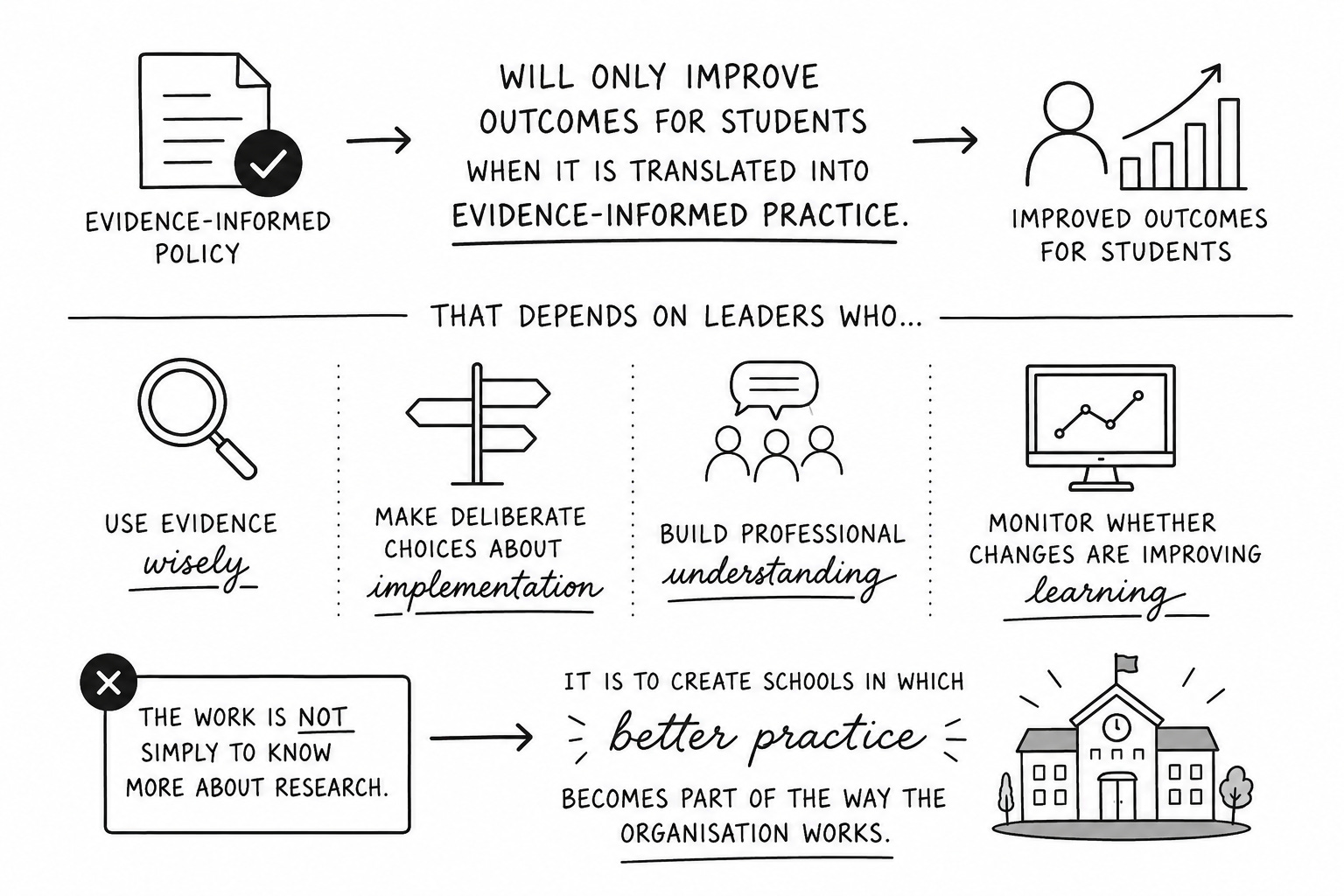
Evidence-informed policy will only improve outcomes for students when it is translated into evidence-informed practice. That depends on leaders who can use evidence wisely, make deliberate choices about implementation, build professional understanding and monitor whether changes are improving learning. The work is not simply to know more about research. It is to create schools in which better practice becomes part of the way the organisation works.
Get in touch - lois@reliable-excellence.com
References
Australian Education Research Organisation. (2024). Implementation in schools: A deliberate and structured approach.
https://www.edresearch.edu.au/resource-collections/implementation-schools-deliberate-and-structured-approachAustralian Education Research Organisation. (2024). Evidence-based teaching practices: A commissioned report.
https://www.edresearch.edu.au/research/research-reports/evidence-based-teaching-practices-commissioned-reportAustralian Institute for Teaching and School Leadership. (2014). Australian Professional Standard for Principals.
https://www.aitsl.edu.au/docs/default-source/national-policy-framework/australian-professional-standard-for-principals.pdfEducation Endowment Foundation. (2024). Putting evidence to work: A school’s guide to implementation.
https://educationendowmentfoundation.org.uk/education-evidence/guidance-reports/implementationSharples, J. (2013). From research to practice: The role of implementation in education. Education Endowment Foundation.
Wiliam, D. (2016). Leadership for teacher learning: Creating a culture where all teachers improve so that all students succeed. Learning Sciences International.
I'm not that familiar with the Australian education system but a lot of what you describe sounds very familiar in the UK. The move towards becoming genuinely evidence informed seems to be raising many of the same opportunities and challenges.
It also chimed with a discussion I wrote last week after visiting Frensham Heights, an innovative private school, where my focus was similarly on practitioner enquiry. Would be very curious to hear your opinion of a school like this: https://samuelkammin.substack.com/p/a-centenary-of-teacher-and-pupil. Do you think schools have become better at consuming research than generating it? It struck me that practitioner enquiry might be one of the missing pieces in the picture you describe. Many thanks for shedding some light on this interesting topic