


Reliable Excellence explores one central idea: how schools create the conditions for every child to experience high-quality learning, every day. Much of the discussion about school improvement quite rightly focuses on improving teaching. Schools invest in curriculum planning, professional development, instructional coaching and assessment because the quality of classroom teaching has a profound influence on pupils’ experiences. Teachers introduce new knowledge, model expert thinking, explain complex ideas and provide carefully structured opportunities for pupils to learn. Yet almost every teacher has experienced the same situation. A lesson appears to go well, pupils answer confidently, work is completed successfully and misconceptions seem to have been addressed, only for much of that learning to fade when it is revisited several weeks later. Successful teaching and durable learning are closely connected, but they are not identical. Schools that want pupils to remember more than yesterday’s lesson need to think just as carefully about what happens after new learning has been introduced.
Understanding how learning becomes secure requires us to look beyond individual lessons and consider what happens over time. Knowledge does not become durable simply because it has been explained clearly once or practised successfully during a single lesson. Children build secure understanding by returning to important ideas, thinking about them again in different contexts, refining their understanding through feedback and connecting new learning with what they already know. Every successful opportunity to revisit learning strengthens the likelihood that knowledge will remain available when pupils need it months or even years later. When schools begin to think about learning in this way, the focus shifts from delivering content efficiently towards designing experiences that allow important knowledge to become established over time.
Although deliberate practice has become a familiar phrase within education, it is often used to describe a collection of classroom strategies rather than the broader principle from which it originated. Retrieval quizzes, repeated exercises, fluency activities and rehearsal are all valuable approaches, yet none captures the complete picture on its own. Deliberate practice is better understood as the intentional design of repeated opportunities for pupils to think carefully about important knowledge, receive meaningful feedback and strengthen their understanding across an extended period of time. This way of thinking places the emphasis on how learning develops rather than on any single teaching technique.
The original concept of deliberate practice emerged through the work of psychologist Anders Ericsson, whose research explored how expertise developed across disciplines including music, sport, medicine and chess (Ericsson, Krampe & Tesch-Römer, 1993). His research demonstrated that expert performance was associated with purposeful practice directed towards specific aspects of performance, accompanied by feedback and sustained over long periods. Although schools are not often preparing concert pianists or elite athletes, the underlying principle transfers well into education. Children do not become confident readers, writers, mathematicians or scientists because they encounter important knowledge once. Their understanding grows stronger when schools provide repeated opportunities to revisit, refine and extend that learning over time.
Viewing deliberate practice through this lens changes the way we interpret classroom activity. A retrieval quiz may provide an excellent opportunity to strengthen learning, but so might a carefully structured discussion, a guided writing lesson, a mathematical explanation, a science investigation or a piece of independent practice. The activity itself is not what determines whether deliberate practice is taking place. What deserves attention is whether pupils are returning to significant knowledge, thinking carefully about it, receiving feedback and using that feedback to improve their understanding. The same principle can be found across every phase of education and every curriculum subject because it is concerned with how learning develops rather than with the particular method chosen by the teacher.
Seeing deliberate practice as a principle rather than a classroom technique also changes where responsibility sits within a school. Individual teachers play an essential role in creating high-quality learning experiences, but no teacher can secure long-term learning through isolated lessons alone. Whether pupils revisit important vocabulary, mathematical procedures, historical concepts or scientific ideas depends upon decisions that reach far beyond one classroom. Curriculum planning determines what knowledge is revisited. Assessment systems identify what needs further attention. Professional development shapes teachers’ understanding of how learning develops. Leadership decisions influence how much curriculum time is protected for revisiting essential knowledge. When these elements work together, pupils encounter coherent opportunities to strengthen learning throughout their time in school rather than relying upon the preferences or habits of individual teachers.
This wider perspective also has implications for education systems as a whole. Curriculum frameworks often describe what pupils should learn, while assessment arrangements measure what they can demonstrate at particular points in time. Neither automatically guarantees that sufficient opportunities exist for important learning to become secure. Schools frequently feel pressure to move rapidly through extensive curriculum content, even when pupils would benefit from spending longer revisiting foundational knowledge. Education systems that genuinely value deep understanding create space for schools to strengthen learning over time rather than rewarding coverage alone. Ambitious curricula are realised through what pupils continue to remember and apply long after teaching has taken place.
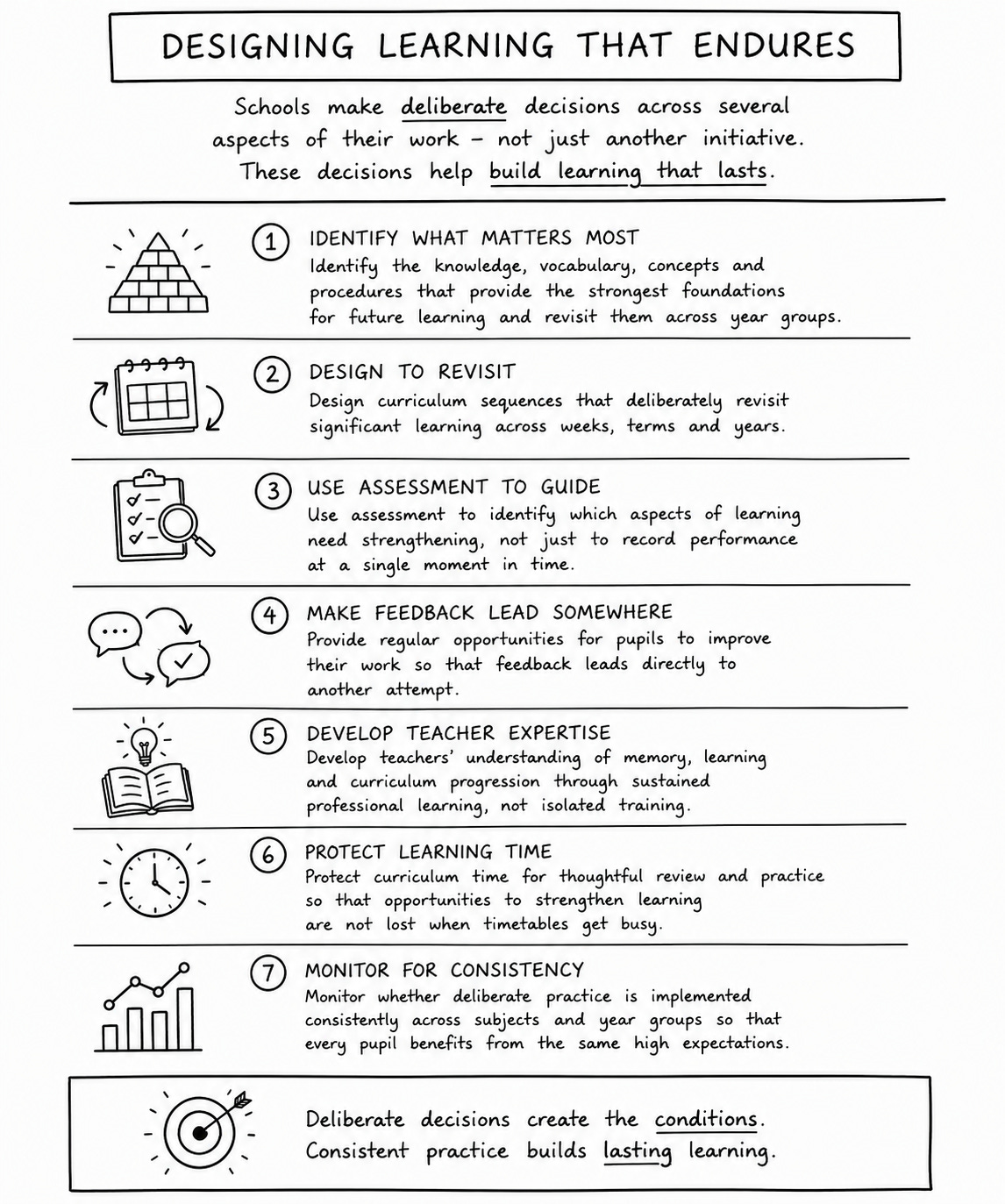
Schools seeking to design learning that endures are likely to make deliberate decisions across several aspects of their work rather than introducing another classroom initiative. These decisions often include:
Identifying the knowledge, vocabulary, concepts and procedures that provide the strongest foundations for future learning and ensuring they receive sustained attention across multiple year groups.
Designing curriculum sequences that deliberately revisit significant learning across weeks, terms and years instead of treating topics as completed once teaching has finished.
Using assessment to identify which aspects of learning require further strengthening rather than simply recording whether pupils answered correctly on one occasion.
Providing regular opportunities for pupils to improve their work following feedback so that advice leads directly to another attempt.
Developing teachers’ understanding of memory, learning and curriculum progression through sustained professional development rather than isolated training events.
Protecting curriculum time for thoughtful review and practice instead of allowing retrieval opportunities to disappear whenever the timetable becomes pressured.
Monitoring whether deliberate practice is implemented consistently across subjects and year groups so that every pupil benefits from the same high expectations.
Weekly spelling tests provide a familiar illustration of why this broader approach is valuable. Many pupils successfully learn a list of words, perform well in a Friday test and appear to have mastered the required spelling pattern. Several weeks later, those same words often begin to reappear incorrectly in independent writing. The assessment captured performance at one point in time, but it did not necessarily strengthen long-term learning. A school designed around deliberate practice treats the spelling test as one point within a much longer sequence. Previously taught spelling patterns return through reading, writing, retrieval, editing and purposeful application over many weeks so that pupils continue strengthening their understanding well beyond the original lesson.
Several complementary areas of cognitive science help explain why this approach has such a positive influence on learning. Research into retrieval practice demonstrates that actively recalling previously learned information strengthens long-term retention more effectively than simply reviewing notes (Roediger & Karpicke, 2006). Studies of spaced practice show that revisiting learning over extended periods produces stronger retention than completing all practice together (Cepeda et al., 2006). Cognitive load theory explains that secure knowledge places fewer demands on working memory, allowing pupils to devote greater attention to more complex thinking (Sweller, 1988). Although these fields developed independently, they all point towards the same conclusion: pupils learn more successfully when important knowledge is revisited thoughtfully over time.
Discussions about school improvement understandably devote significant attention to improving the quality of teaching because excellent teaching remains indispensable. At the same time, schools that wish pupils to retain, connect and apply their learning must also consider how that learning is strengthened after it has first been introduced. Deliberate practice offers a useful way of thinking about curriculum, assessment, professional development and leadership because it directs attention towards the experiences pupils have across months and years rather than within isolated lessons. Designing learning that lasts is ultimately an organisational responsibility. When schools intentionally create repeated opportunities for pupils to revisit important knowledge, refine their understanding and build lasting confidence, they give far more children the opportunity to experience lasting success in education.
References
Cepeda, N. J., Pashler, H., Vul, E., Wixted, J. T., & Rohrer, D. (2006). Distributed practice in verbal recall tasks: A review and quantitative synthesis. Psychological Bulletin, 132(3), 354–380. https://doi.org/10.1037/0033-2909.132.3.354
Ericsson, K. A., Krampe, R. T., & Tesch-Römer, C. (1993). The role of deliberate practice in the acquisition of expert performance. Psychological Review, 100(3), 363–406. https://doi.org/10.1037/0033-295X.100.3.363
Roediger, H. L., III, & Karpicke, J. D. (2006). Test-enhanced learning: Taking memory tests improves long-term retention. Psychological Science, 17(3), 249–255. https://doi.org/10.1111/j.1467-9280.2006.01693.x
Rosenshine, B. (2012). Principles of instruction: Research-based strategies that all teachers should know. American Educator, 36(1), 12–19, 39.
Sweller, J. (1988). Cognitive load during problem solving: Effects on learning. Cognitive Science, 12(2), 257–285. https://doi.org/10.1207/s15516709cog1202_4