


Joyful rigour is, arguably, what we want every child to experience at school. It describes classrooms where teaching is precise, expectations are high, knowledge is carefully sequenced and thinking is demanding, while children feel curious, confident and genuinely pleased to be at school. Doug Lemov describes this through the J-Factor: classrooms where academic ambition is accompanied by enthusiasm, warmth and shared enjoyment because children experience the satisfaction of learning something difficult. Joy is not an alternative to rigour. It is part of what makes rigorous learning worthwhile.
For many school leaders, that vision is an attractive one. The more difficult question is how to build it. Joyful rigour is built over time, particularly in schools where teaching, culture or systems require strengthening. Developing expertise takes time, yet children only experience each year at school once. They should not have to wait for the school we are trying to build before experiencing the school they deserve.
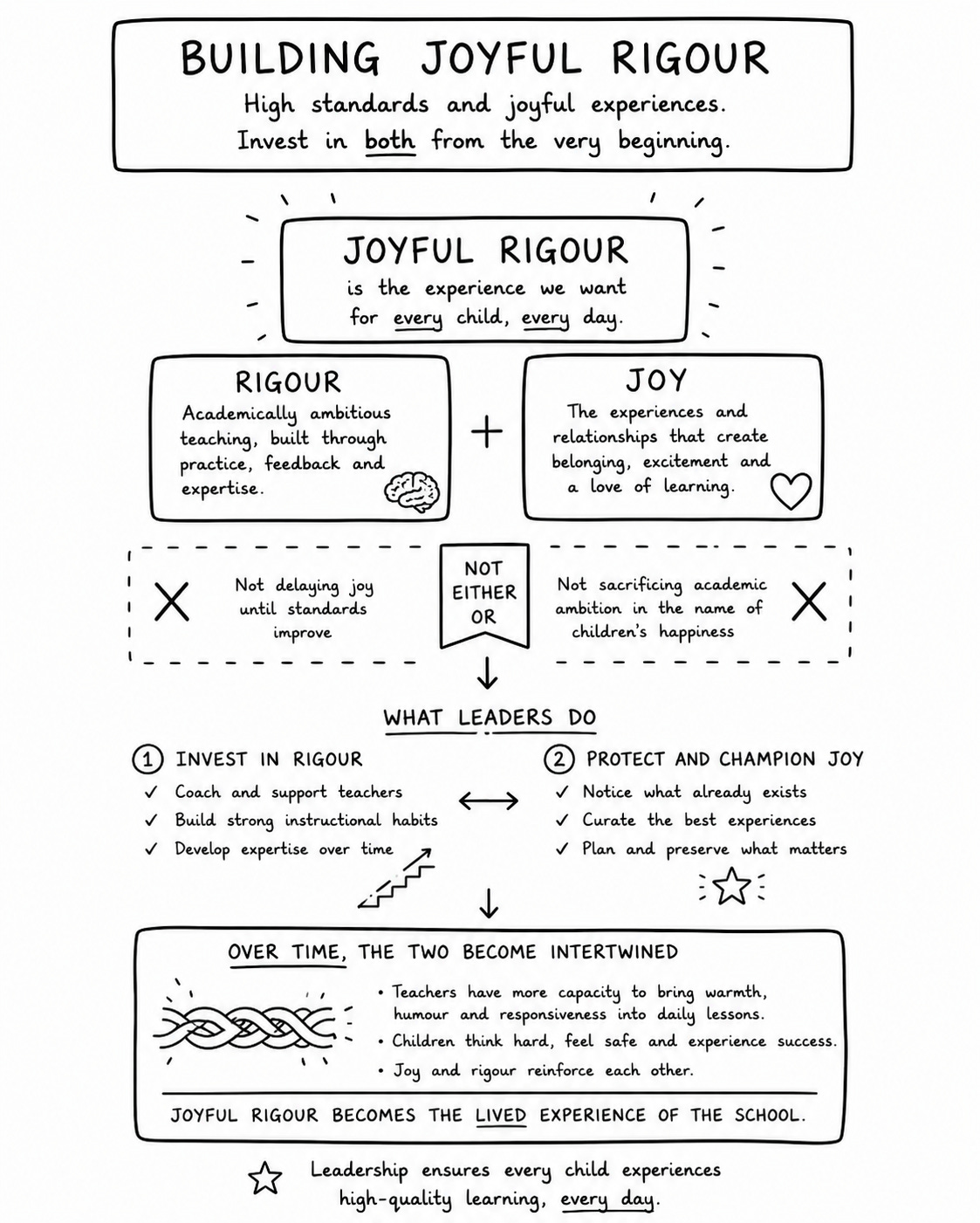
The starting point is recognising that joyful rigour is not created by focusing on one priority at the expense of the other. It can be tempting, particularly when standards need to rise, to concentrate every ounce of energy on strengthening instruction with the intention of returning to the joyful parts of school later. Equally, it can be tempting to protect enjoyable experiences while avoiding the disciplined work required to improve teaching. Neither approach leads to joyful rigour. Leadership begins by demonstrating that both matter equally from the very beginning.
Fortunately, we know far more about how to build rigorous teaching than we once did. Research into cognitive science has strengthened professional understanding of curriculum design, explicit instruction, retrieval practice, cognitive load and assessment. It has also deepened our understanding of how adults develop expertise. Learning something new places demands on working memory, while new habits require deliberate practice, timely feedback and repeated opportunities to become automatic. Knowing what excellent teaching looks like is only the starting point. Instructional coaching, carefully designed professional development and disciplined implementation provide teachers with opportunities to practise, refine and embed those habits until they become increasingly fluent.
Teaching is a complex profession, and learning to teach exceptionally well requires both time and practice. When teachers are developing new instructional habits, much of their attention is naturally devoted to recalling explanations, modelling accurately, checking understanding and making deliberate instructional decisions. This is not a weakness. It is simply how learning works. Effective coaching accelerates that journey, but it cannot remove it entirely. As expertise develops, instructional habits become increasingly automatic, releasing greater capacity to notice children’s thinking, respond instinctively to misconceptions and allow warmth, humour and personality to become more visible within the lesson. Rigorous teaching does not become joyful because expectations have been lowered. It becomes joyful because expertise creates the freedom to combine ambitious learning with genuine human connection.
Children, however, should not have to wait for that process to unfold before they experience joy at school. This is why protecting joy deserves the same deliberate attention as strengthening teaching. Even schools facing the greatest challenges usually contain examples of the culture they want to create. They may already have a much-loved learning celebration, a successful production, a community fundraiser, an enrichment visit, sporting success, artwork displayed with pride or trusted adults who help children feel known and valued every day. Leaders should notice those moments, curate the strongest examples, protect them and give them a platform. Where they do not yet exist, schools should intentionally establish a small number of meaningful traditions that can be sustained well. The goal is not to fill the calendar with events. It is to ensure children continue to experience belonging, enjoyment and connection while instructional expertise develops.
At first, this can feel like two separate priorities. Schools are deliberately strengthening teaching while deliberately protecting the experiences that make childhood memorable. That is not a compromise. It reflects the reality that children deserve both from the moment they arrive.
Over time, those two strands begin to merge. As teachers become increasingly fluent in the habits of rigorous instruction, they naturally begin to weave joy more consistently into everyday learning. They have greater capacity to notice the moments worth celebrating, respond with humour, adapt to children’s thinking and create lessons that are intellectually demanding as well as deeply engaging. Joy gradually becomes less dependent on special events because it is increasingly present within the daily experience of the classroom. Productions, concerts and enrichment opportunities still matter, but they are complemented by classrooms where children experience the satisfaction of thinking hard, succeeding and feeling connected to the adults who teach them.
This is how joyful rigour is built. It is not achieved by postponing joy until standards improve, and it is not achieved by sacrificing academic ambition in the name of children’s happiness. It develops when leaders invest in both with equal conviction: creating the conditions for teachers to master the craft of teaching while protecting the experiences that make children love coming to school. Over time, those two strands become increasingly intertwined until joyful rigour is no longer an aspiration but the lived experience of the school.
Creating joyful rigour means recognising that excellence develops over time, while childhood does not. Leadership is about ensuring children experience belonging, enjoyment and ambitious learning today, while patiently helping teachers develop the expertise that allows those qualities to become increasingly intertwined across every classroom. If our ambition is to ensure every child experiences high-quality learning, every day, joyful rigour is not something we introduce once everything else is in place. It is the standard we should work towards from the very beginning.
References
Bambrick-Santoyo, P. (2018). Leverage Leadership 2.0: A Practical Guide to Building Exceptional Schools. Jossey-Bass.
Lemov, D. (2021). Teach Like a Champion 3.0. Jossey-Bass.
Rosenshine, B. (2012). Principles of Instruction: Research-Based Strategies That All Teachers Should Know. American Educator, 36(1), 12–19, 39.
Ryan, R. M., & Deci, E. L. (2020). Intrinsic and Extrinsic Motivation from a Self-Determination Theory Perspective: Definitions, Theory, Practices, and Future Directions. Contemporary Educational Psychology, 61, 101860.
This is beautifully explained and illustrated. Thank you