


Reliable Excellence explores a simple but important question:
How do we ensure that every child experiences high-quality learning, every day?
Answering that question requires us to think carefully about how learning happens. If we want more children to learn successfully, we need teaching approaches that align with what we know about memory, attention, practice and understanding. Recently, explicit instruction has been promoted in Australia as an important driver of improving outcomes for children. There are good reasons for this. Explicit instruction aligns closely with a substantial body of evidence about how learning happens and can be highly effective, particularly when students are learning new knowledge and skills.
However, discussions about the science of learning can sometimes become discussions about explicit instruction. While the two are connected, they are not the same thing. The science of learning provides an understanding of how learning occurs. Explicit instruction is one response to that understanding. Confusing the two risks narrowing professional conversations and overlooking the importance of professional judgement in translating evidence into effective classroom practice.
The science of learning is not a teaching method. It is an understanding of how learning occurs. It draws upon research from cognitive psychology and related disciplines to help us understand memory, attention, cognitive load, retrieval, practice and feedback. These insights help explain why some approaches are more likely to support learning than others.
Importantly, the science of learning does not prescribe a single way of teaching. Rather, it provides principles that can guide professional decision-making.
Understanding that working memory is limited helps teachers appreciate the importance of clear explanations, carefully sequenced learning and avoiding unnecessary distractions. Understanding the role of retrieval encourages teachers to revisit previously taught content and strengthen long-term memory. Understanding the importance of practice helps teachers provide opportunities for students to develop fluency and competence.
Explicit instruction is one response to these findings. It is often an excellent response. However, it is not the only response.
A student encountering a concept for the first time may benefit from highly explicit modelling, worked examples and guided practice. Later in the learning process, the same student may benefit from independent practice, discussion, problem-solving or extended application. The science of learning supports both decisions because the purpose of teaching has changed. The teacher is responding to what is known about learning and to the needs of the learner.
This is where professional judgement becomes essential.
Professional judgement sits at the heart of effective teaching. It is not a rejection of evidence and it is not complete freedom to teach however one chooses. It is the ability to understand evidence, interpret it thoughtfully and apply it within a specific context. It involves understanding the principles that underpin learning and making informed decisions about how best to support students at a particular moment in time.
This distinction matters greatly for leaders.
When improvement efforts focus solely on a particular programme, strategy or teaching approach, implementation can become compliance-driven. Teachers may learn to reproduce techniques without fully understanding the principles that make those techniques effective. Over time, this can lead to superficial adoption rather than genuine improvement.
When teachers understand the evidence that underpins their practice, they are better equipped to adapt, refine and respond to the needs of their students while remaining faithful to the principles that support learning. Sustainable improvement depends not only on what teachers do, but on what they understand.
This challenge becomes even more significant at system level. Large education systems have an important role in identifying approaches that are likely to improve outcomes for children. However, identifying an approach is only the beginning. Sustainable improvement requires investment in leadership development, professional learning, coaching and implementation support. Teachers and leaders need opportunities to understand the evidence, explore its implications and develop the expertise required to apply it effectively within their own contexts.
Without this infrastructure, there is a risk that educational reform becomes reduced to compliance. Schools may adopt the language of a reform without fully understanding the principles that sit behind it. Some schools will build deep expertise and strong implementation, while others will interpret the same expectations very differently. Variation becomes inevitable.
The most successful systems do more than promote effective practices. They build the capability of teachers and leaders to make informed professional decisions. They create a shared understanding of learning while recognising that effective implementation requires knowledge, expertise and judgement. The goal is not to create identical classrooms. The goal is to ensure that decisions across those classrooms are consistently informed by a secure understanding of how learning happens.
Announcing a preferred approach is relatively straightforward. Developing the professional knowledge required to implement that approach effectively across hundreds or thousands of schools is considerably more demanding. Sustainable improvement depends not only on identifying effective practices but also on building the capability of teachers and leaders to understand, apply and refine those practices over time.
Children only experience one education. They cannot wait for the next initiative, the next debate or the next shift in policy direction. They need classrooms where teaching is informed by the best available evidence and delivered by professionals who understand how learning happens.
The goal should not be to win pedagogical arguments. The goal should be to help students learn.
The science of learning provides a valuable foundation for achieving that aim. It helps us understand how learning happens and offers principles that can guide professional decision-making. Explicit instruction is often an important part of that picture, particularly when students are acquiring new knowledge and skills. However, it is most powerful when understood as one tool within a broader evidence-informed approach to teaching.
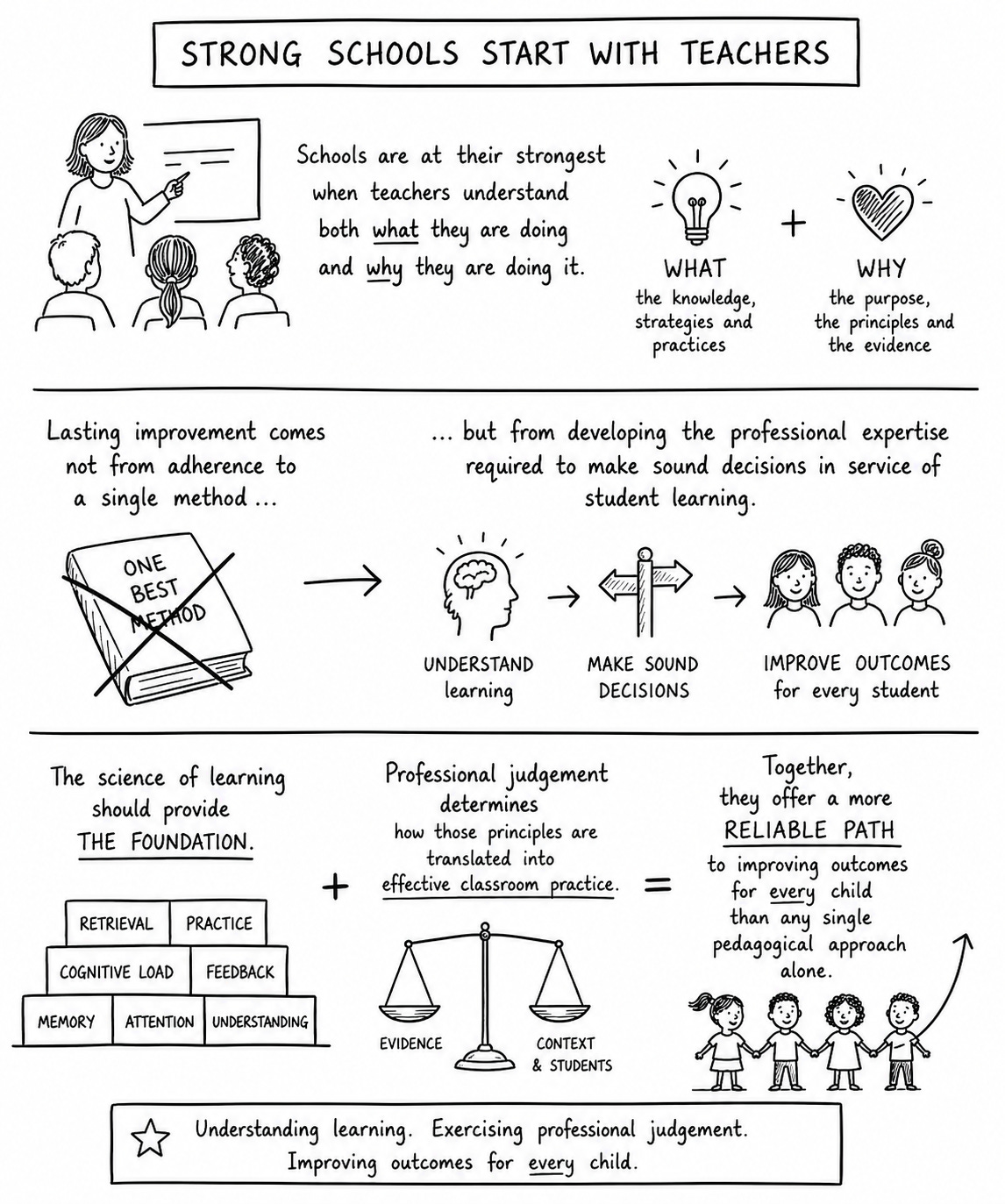
Schools are at their strongest when teachers understand both what they are doing and why they are doing it. Lasting improvement comes not from adherence to a single method but from developing the professional expertise required to make sound decisions in service of student learning.
The science of learning should provide the foundation, while professional judgement determines how those principles are translated into effective classroom practice. Together, they offer a more reliable path to improving outcomes for every child than any single pedagogical approach alone.
References
Bjork, R. A., & Bjork, E. L. (2020). Desirable Difficulties in Theory and Practice. Journal of Applied Research in Memory and Cognition, 9(4), 475–479.
Rosenshine, B. (2012). Principles of Instruction: Research-Based Strategies That All Teachers Should Know. American Educator, 36(1), 12–39.
Sweller, J., Ayres, P., & Kalyuga, S. (2011). Cognitive Load Theory. New York: Springer.
Willingham, D. T. (2009). Why Don’t Students Like School? San Francisco: Jossey-Bass.
The best educational study was Project Follow Through. Over 10 year study, which showed DI had most positive results.