


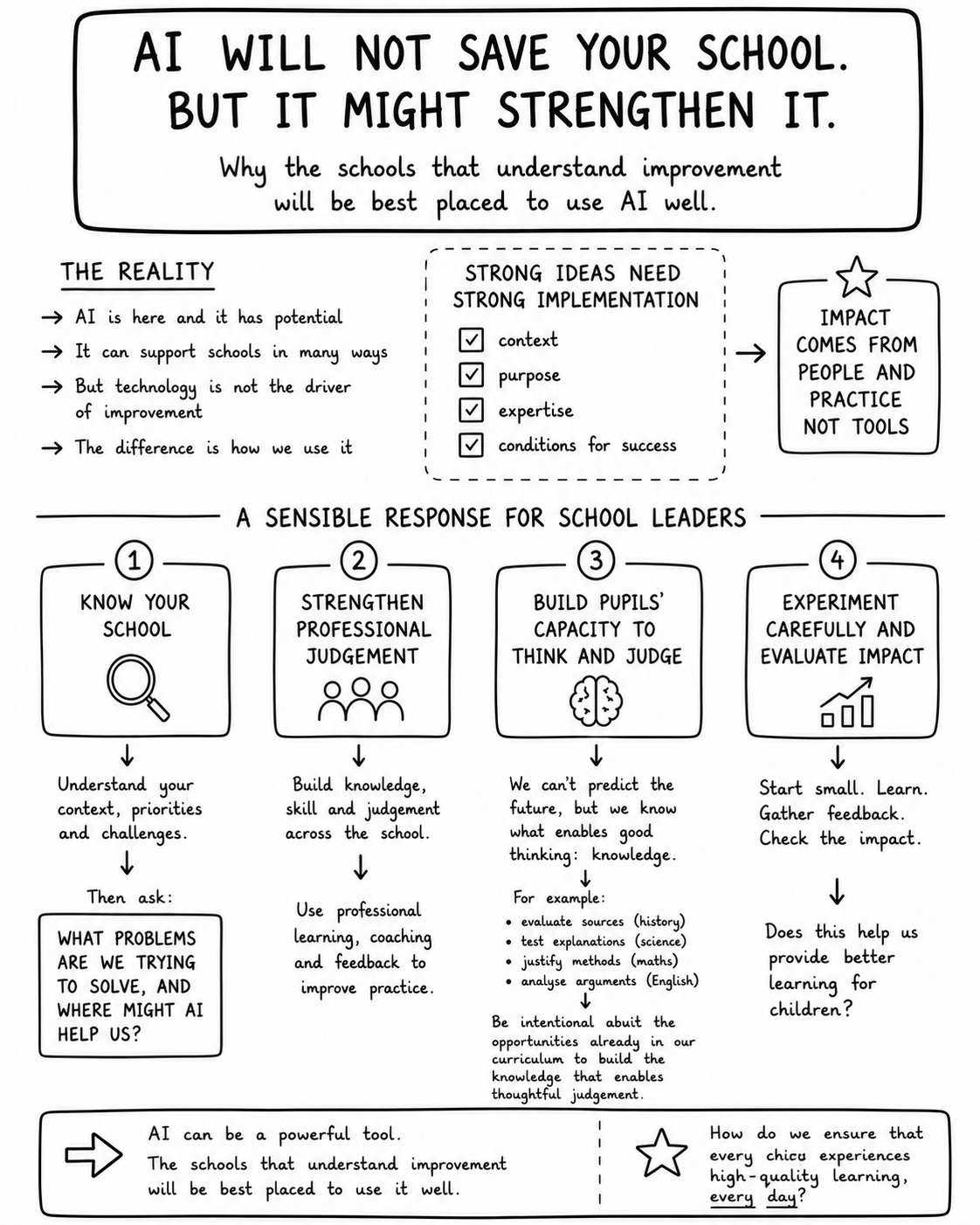
Conversations about artificial intelligence are everywhere. Some see it as an extraordinary opportunity to improve education, while others are concerned about what it might mean for teaching, learning and the future of work. For school leaders, AI can feel like another significant challenge arriving on an already crowded landscape. Staff are asking questions, pupils are experimenting with new tools, parents and governors may want reassurance, and new developments appear constantly. It is natural for schools to begin by asking what action they need to take: which tools should we use, what policies do we need and what training should we provide? These are important questions, but I think there is a more useful starting point: what problems are we trying to solve, and how can we ensure that any response strengthens teaching and learning?
Throughout my career in education, I have seen how much thought and care leaders put into improving outcomes for children. Schools are constantly exploring approaches that might strengthen teaching and learning. The difficulty is that even strong ideas require more than simply introducing them; they need to be understood within the context of the school, connected to a clear purpose and supported by the conditions that allow them to succeed.
We have seen this with many approaches in education. Systematic phonics, for example, has strong evidence behind it, but the introduction of a programme alone does not improve reading outcomes. The impact comes from teachers understanding the approach, receiving appropriate support, using assessment effectively and adapting their practice in response to pupils. Similarly, playbooks can help schools clarify effective practice, but a document itself does not change classroom teaching. Improvement comes through the professional conversations, modelling, coaching and feedback that help people understand and embed that practice.
Artificial intelligence is likely to follow the same pattern. Its potential is significant, but the value it creates will depend on the decisions schools make around its use. Technology can support schools in many ways, from reducing unnecessary administrative workload to helping teachers and leaders use their time more effectively. However, the technology itself is not what creates improvement. The important work is deciding where it can genuinely add value and where human expertise remains essential.
This is why AI should be approached in the same way as any other school improvement strategy. The strongest schools understand their priorities, identify areas for improvement and consider whether a proposed approach will help them move closer to their goals. They are willing to explore new ideas, but they also evaluate carefully whether those ideas are improving outcomes for children.
A sensible response for school leaders
For leaders considering how to respond to AI, the starting point is not to ignore it or rush towards it. It is to apply the same disciplined thinking that supports effective school improvement: understand your context, identify the problem(s) you are trying to solve and evaluate whether a change is making a meaningful difference.
1. Know your school before introducing new solutions
Before exploring possible uses of AI, leaders need a clear understanding of their current reality. What is working well? Where are the greatest opportunities for improvement? What are teachers and pupils already doing? Where are people spending time on tasks that could be improved?
This allows schools to move beyond simply asking, “What can AI do?” and towards a more useful question:
“What problems are we trying to solve, and where might AI help us?”
A school that understands its priorities is much more likely to identify meaningful uses of AI than a school that begins with the technology itself.
2. Strengthen professional judgement across the organisation
As information becomes easier to generate, professional judgement becomes even more important. Teachers and leaders need to evaluate whether information is accurate, appropriate and useful, and whether a particular tool or approach will genuinely improve learning.
Sustainable improvement depends on people understanding the purpose behind decisions and making thoughtful choices aligned with the school’s aims. There are times when leaders need to provide greater direction, particularly when practice is inconsistent or outcomes are not where they need to be. However, long-term success depends on developing the expertise of the people within the organisation.
This is why professional learning, instructional coaching and meaningful feedback remain central. The aim is not simply to implement approaches consistently; it is to build the understanding needed to improve practice over time.
3. Continue building pupils’ capacity to think and judge
One of the understandable concerns around AI is whether schools need to introduce new curriculum content to prepare children for a future shaped by technology. However, predicting exactly what knowledge and skills pupils will need in the future is difficult. A more useful starting point is to return to what we already know about learning.
We know that children need secure knowledge in order to think critically, evaluate information and make sound judgements. These capabilities are becoming increasingly important in an AI-enabled world, where pupils will encounter vast amounts of information and will need to decide what is accurate, useful and trustworthy.
This reinforces an important principle about learning: knowledge and skills are deeply connected. Children cannot evaluate ideas they do not understand or make informed judgements without knowledge to draw upon. Knowledge provides the foundation that allows critical thinking, reasoning and problem solving to develop.
Many of these opportunities already exist within a strong curriculum. For example, when pupils evaluate the reliability of a historical source, test a scientific explanation, justify a mathematical method or analyse the effectiveness of a persuasive text, they are developing the judgement they will need to navigate a world where information can increasingly be generated by technology.
The implication for schools is not necessarily that we need to add more content. Instead, we should be increasingly intentional about the opportunities already within our curriculum to build the knowledge that enables thoughtful judgement. By continuing to develop pupils’ understanding of the world, we place them in a stronger position to evaluate information, use technology wisely and respond confidently to future changes.
4. Experiment carefully and evaluate impact
Schools cannot wait for every question about AI to be answered before engaging with it, but neither should they adopt tools without careful consideration.
The most effective organisations create opportunities to explore, test and learn. They begin with a clear purpose, gather feedback from those involved and evaluate whether a change is producing the intended benefits. Small-scale experimentation can help schools understand where AI is genuinely useful while also identifying potential risks.
Ultimately, the question is whether a particular use of AI helps schools provide better learning experiences for children.
Artificial intelligence may change aspects of education, but it does not change the fundamental work of schools. The schools that use it well will be those that continue to focus on what has always mattered: understanding their purpose, developing expertise, evaluating evidence and improving practice.
In moments of rapid change, it becomes even more important to return to the question that guides every decision we make in education:
How do we ensure that every child experiences high-quality learning, every day?
Get in touch - lois@reliable-excellence.com
References
Christodoulou, D. (2014). Seven Myths About Education. Routledge.
Education Endowment Foundation. (2024). Implementation guidance report. Education Endowment Foundation. https://educationendowmentfoundation.org.uk/education-evidence/guidance-reports/implementation
Hattie, J. (2023). Visible Learning: The Sequel. Routledge.
Schwartz, R., Ferguson, R., D’Souza, S., & Wilkins, A. (2024). Centennials: The 12 Habits of Great, Enduring Organisations. Wiley.