


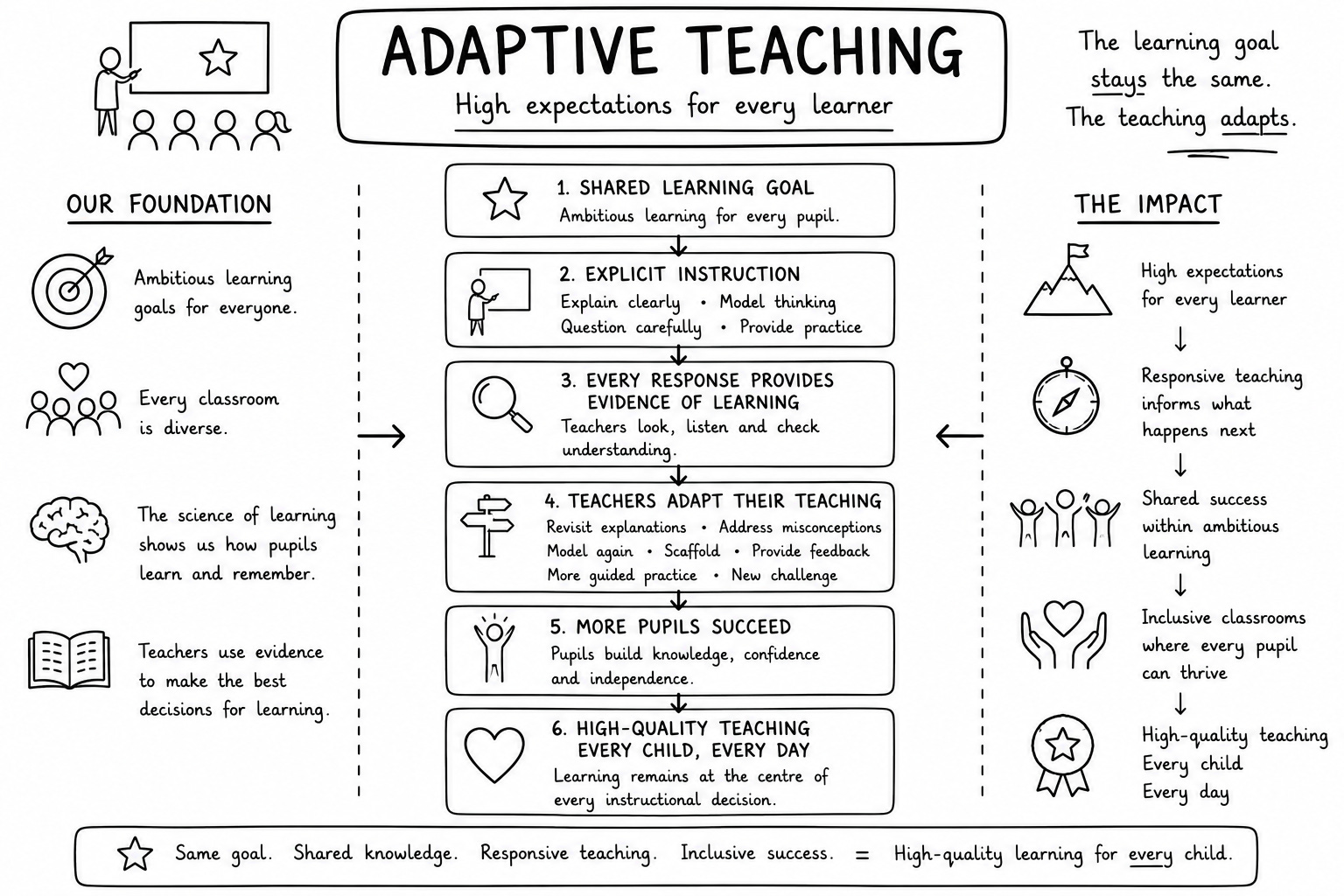
How do we ensure every child experiences high-quality learning, every day? It is a question that sits behind curriculum design, assessment, behaviour, professional learning and school improvement. Every decision made by leaders and teachers ultimately succeeds or fails through its influence on learning. As our understanding of learning has developed, so too has our understanding of what effective teaching looks like. One of the clearest examples is the growing emphasis on adaptive teaching. Increasingly, it has become the language of evidence-informed practice because it reflects what we know about how children learn and how teachers can help more pupils succeed within an ambitious curriculum.
Every classroom presents teachers with pupils who arrive with different experiences, different levels of prior knowledge and different misconceptions. Some grasp new ideas quickly, while others require further explanation, additional practice or carefully chosen support before learning becomes secure. These differences are entirely normal. They are not problems to eliminate but characteristics of every class that teachers must understand if learning is to flourish.
Responding to those differences has always been part of good teaching. What has changed is our understanding of how that responsiveness should look in practice. As research into learning has expanded, greater attention has been given to the decisions teachers make while teaching rather than simply the activities pupils complete. Adaptive teaching reflects this change in professional thinking. The focus has shifted from planning different activities to making responsive instructional decisions that help more pupils succeed within the same ambitious curriculum.
A shared destination
Every lesson begins with a decision about what pupils should learn. Before resources are produced, examples selected or explanations prepared, teachers identify the knowledge, understanding or skill that pupils should secure. That intended outcome provides direction for every decision that follows. Adaptive teaching does not alter the destination. It influences how teachers help pupils reach it.
This principle represents an important shift in professional thinking. For many years, differentiation was often interpreted as creating different activities for different groups of pupils. In some classrooms this evolved into simplified tasks for those who were struggling and more demanding work for those who appeared ready to move ahead. Although these approaches were usually motivated by a desire to support learners, they sometimes reduced access to the very knowledge that pupils most needed to acquire.
Adaptive teaching begins from a different assumption. Every pupil is entitled to an ambitious curriculum because powerful knowledge should not depend upon how quickly a child learns. The learning goal remains shared across the class. Variation lies in the teaching, the support and the opportunities pupils receive to secure that learning.
Strong teaching creates the conditions for adaptation
Discussion about adaptive teaching can sometimes create the impression that responsiveness begins when teachers notice pupils struggling. In reality, adaptation begins much earlier than that. Its quality depends almost entirely upon the quality of the instruction that comes before it.
Clear explanations, carefully chosen examples, expert modelling and guided practice provide pupils with the knowledge they need to begin thinking successfully about new ideas. They also provide teachers with the first opportunity to observe how learning is developing. Without secure initial instruction, there is very little useful evidence upon which adaptation can be based.
This reflects what cognitive science tells us about learning. New knowledge is constructed by connecting new information to existing knowledge held in long-term memory. That process is strengthened through retrieval, practice and feedback. Effective teaching makes these connections easier to establish by reducing unnecessary cognitive load and directing pupils’ attention towards the ideas that are most important. Adaptive teaching builds upon these foundations; it does not replace them.
Learning leaves clues
One of the most distinctive features of expert teaching is the ability to notice learning while it is happening. Every classroom interaction offers clues about pupils’ thinking. A hesitant response, an unexpected misconception, a confident explanation or an error in a worked example all reveal something about what pupils currently understand.
This evidence is gathered continuously. It is collected through questioning, observation, discussion and pupils’ written work. Unlike formal assessment, which often looks back at what has been learned, responsive assessment allows teachers to shape learning while it is still taking place. Small misunderstandings can be addressed before they become embedded, while secure understanding can be extended before pupils lose momentum.
Perhaps one of the most underestimated aspects of adaptive teaching is the professional expertise required to interpret these clues accurately. Knowing that a pupil has answered incorrectly is relatively straightforward. Understanding why they answered incorrectly, and deciding what should happen next, demands secure subject knowledge, pedagogical expertise and a deep understanding of how learning develops.
Small decisions, significant consequences
Much of adaptive teaching consists of decisions that appear almost invisible to anyone watching a lesson. A teacher may choose to model another example, rephrase an explanation, return briefly to prior learning or provide additional guided practice before pupils continue independently. At other times, support may be gradually withdrawn because pupils have demonstrated that they are ready to take greater responsibility for their learning.
None of these decisions alters the intended outcome. Instead, they increase the likelihood that more pupils will reach it. Scaffolds such as sentence stems, visual representations and worked examples are introduced when they help pupils think more successfully and removed when they are no longer required. Their purpose is temporary. They support learning without reducing ambition.
These adjustments may appear modest in isolation, yet together they shape the quality of learning that pupils experience every day. They illustrate why adaptive teaching is far more dependent upon professional judgement than additional resources. The expertise lies in recognising which adaptation is required, when it is required and when it is no longer needed.
Professional judgement remains central
The growing availability of high-quality curriculum materials has transformed classroom practice in many schools. Teachers now have access to carefully sequenced curriculum, high-quality resources and evidence-informed guidance that would have been difficult to imagine only a decade ago. These developments strengthen teaching considerably, but they do not diminish the importance of professional expertise. They change where that expertise is invested.
Every curriculum eventually meets a real classroom. Pupils respond differently, misconceptions emerge unexpectedly and understanding develops at different rates. Adaptive teaching is the professional judgement that bridges the gap between a well-designed curriculum and the pupils sitting in front of the teacher. It ensures that a degree of flexibility sits alongside curriculum fidelity and that responsiveness does not become reduced ambition.
High-quality learning for every child, every day
Adaptive teaching has become a defining feature of evidence-informed practice because it reflects a more sophisticated understanding of learning. It recognises that ambitious expectations, explicit instruction, responsive assessment and professional judgement work together to create the conditions in which more pupils experience success.
Perhaps this explains why adaptive teaching has gained such prominence in recent years. It offers a way of responding to the natural diversity found in every classroom without compromising the ambition of the curriculum. The destination remains shared, while the teaching responds thoughtfully to the evidence of learning that emerges along the way.
Ultimately, adaptive teaching is not simply another approach to classroom practice. It is the practical application of a simple principle: every child deserves access to high-quality teaching that responds to their learning while maintaining ambitious expectations. Adaptive teaching is one of the clearest expressions of our commitment to ensuring every child experiences high-quality learning, every day.
References
Education Endowment Foundation. (2021). Teacher Feedback to Improve Learning: Guidance Report.
Education Endowment Foundation. (2021). Teaching and Learning Toolkit.
Education Endowment Foundation. (2025). Metacognition and Self-Regulation: Guidance Report.
Leswell, M. (2025). The Shift to Adaptive Teaching: A Research-Informed Guide. Impact, Chartered College of Teaching.