

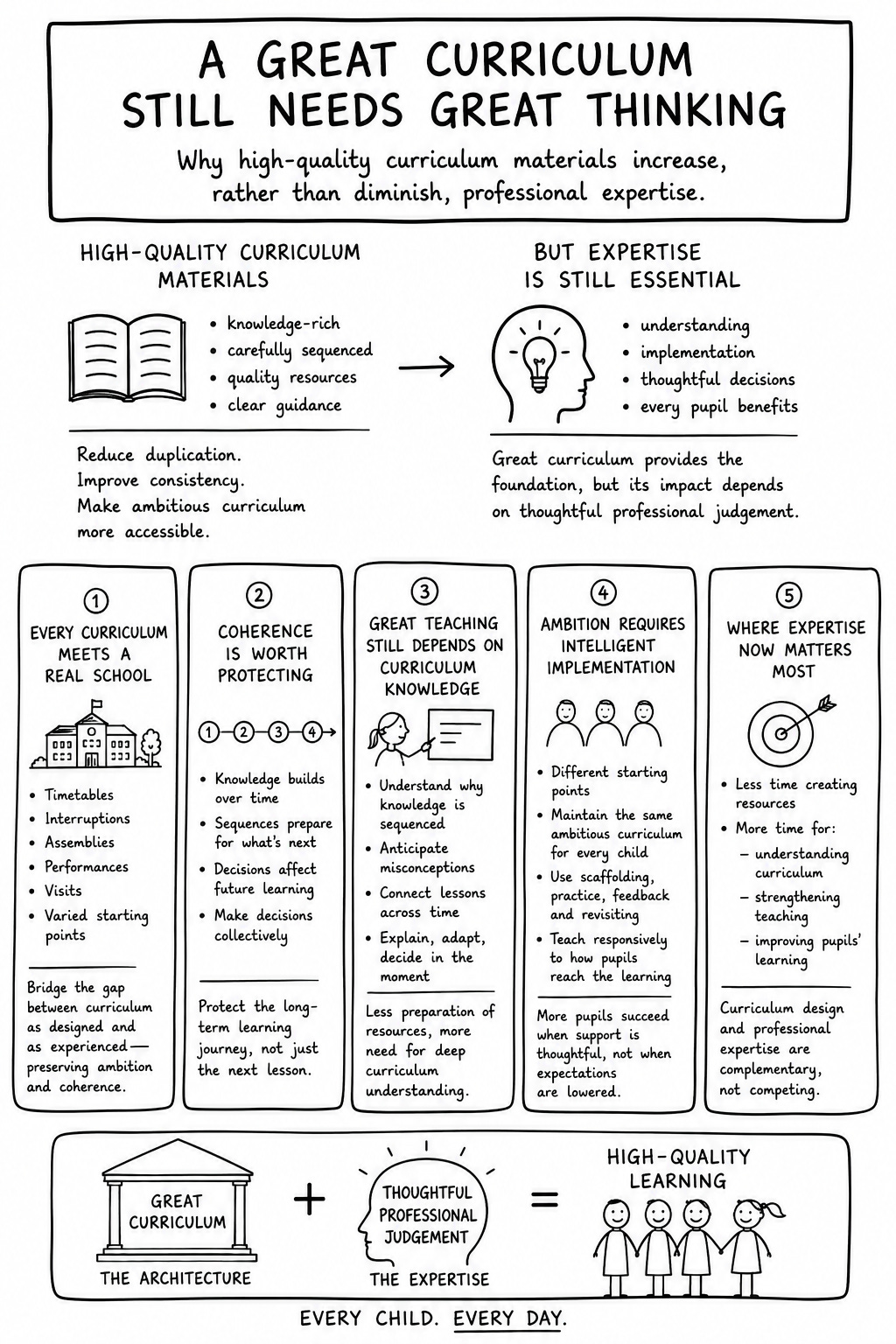
How do we ensure every child experiences high-quality learning, every day? This is a key question that underpins school improvement. Over recent years, one of the most significant developments in education has been the availability of high-quality, knowledge-rich curriculum materials. Carefully sequenced curricula, thoughtfully designed lesson resources and accompanying guidance have reduced the need for every school to create its own curriculum from scratch. Schools should embrace these developments. They reduce duplication, improve consistency and make ambitious curriculum more accessible than ever before.
The availability of high-quality curriculum materials does not, however, reduce the importance of professional expertise. It changes where that expertise is invested. When less time is spent creating resources, more time can be devoted to understanding the curriculum, implementing it thoughtfully and ensuring that every pupil benefits from it. Great curriculum materials provide the foundation for improving learning, but they achieve their greatest impact when accompanied by thoughtful professional judgement.
Every curriculum meets a real school
Every published curriculum is written for an imagined classroom. Curriculum designers make informed assumptions about teaching time, pupils’ prior knowledge and the sequence of learning they are likely to experience, but they cannot know the reality of every school. They cannot anticipate assemblies, performances, educational visits, timetable constraints or the variations in knowledge that pupils bring with them.
The first responsibility of teachers and leaders is to bridge the gap between the curriculum as designed and the curriculum as experienced. This is not an invitation to rewrite carefully considered curriculum according to personal preference. Instead, it requires schools to understand the curriculum well enough to implement it successfully within their own context while preserving its ambition and coherence.
Coherence is worth protecting
The strength of knowledge-rich curricula is the deliberate sequencing of knowledge over time. Individual lessons make sense because they contribute to a much larger journey of learning, with each unit preparing pupils for what comes next. That coherence is easily weakened if curriculum decisions are made lesson by lesson or year by year without considering their wider consequences.
School leaders and teachers inevitably make decisions about curriculum throughout the year. Time is finite, and published curricula often contain more material than schools can realistically teach once the demands of school life are taken into account. Deciding what must be protected, where there is flexibility and how each year prepares pupils for the next requires careful professional judgement. These decisions are strongest when they are made collectively, with a shared understanding of the curriculum’s overall design rather than from the perspective of individual classrooms. Protecting curriculum coherence means safeguarding the long-term learning journey rather than simply delivering the next lesson.
Great teaching still depends on curriculum knowledge
High-quality resources remove much of the work involved in producing slides, worksheets and lesson activities, but they do not reduce the need for teachers to know the curriculum deeply. If anything, they make that knowledge even more important.
Teachers need to understand why knowledge has been sequenced in a particular way, anticipate misconceptions before they arise and recognise how each lesson connects to previous and future learning. Teachers should not encounter the next slide for the first time alongside their pupils. Secure curriculum knowledge allows teachers to explain ideas with greater precision, adapt explanations when pupils struggle and make better decisions throughout the lesson. High-quality curriculum materials reduce preparation, but they increase the importance of curriculum understanding.
Ambition requires intelligent implementation
Every classroom contains pupils whose starting points, confidence and prior knowledge differ. Published curricula cannot anticipate every variation, yet ambitious curriculum should remain the entitlement of every child. The professional task is not to reduce ambition when pupils find learning difficult, but to consider how they can be supported to succeed within it.
This may involve carefully planned scaffolding, additional practice, timely feedback or targeted opportunities to revisit essential knowledge before new learning is introduced. Such decisions depend on teachers understanding both the curriculum and the pupils sitting in front of them. The curriculum remains constant, while teaching becomes increasingly responsive to how pupils reach it. Thoughtful implementation enables more pupils to succeed without weakening the ambition of what they are expected to learn.
Where professional expertise now matters most
The growth of high-quality curriculum materials represents genuine progress for the profession. Teachers should spend less time searching for resources and producing worksheets because those tasks are no longer where their expertise has the greatest value. The profession benefits when that time is redirected towards understanding curriculum, strengthening teaching and improving pupils’ learning.
As more schools adopt high-quality, knowledge-rich curricula, successful implementation will depend less on the resources themselves and more on the professional thinking that surrounds them. Curriculum design and professional expertise are not competing priorities. They are complementary. A great curriculum provides the architecture for learning, while thoughtful professional judgement ensures that architecture becomes a lived experience for every child, every day.
References
Christodoulou, D. (2014). Seven myths about education. Routledge.
Counsell, C. (2018). Taking curriculum seriously. Collection of essays and conference papers.
Rosenshine, B. (2012). Principles of instruction: Research-based strategies that all teachers should know. American Educator, 36(1), 12–19, 39.
Sweller, J., Ayres, P., & Kalyuga, S. (2011). Cognitive load theory. Springer.
Wiliam, D. (2011). Embedded formative assessment. Solution Tree Press.
Willingham, D. T. (2009). Why don’t students like school? Jossey-Bass.