


Reliable Excellence explores an important question:
How do we ensure that every child experiences high-quality learning, every day?
Schools exist to help children learn. Research from cognitive psychology has helped establish a widely accepted definition of learning as a relatively lasting change in what pupils know, understand and can do. If learning is the central purpose of schooling, decisions about school improvement should ultimately be judged by their contribution to the quality of learning experienced by pupils.
This raises an important practical question. Once a school has established clarity about its purpose, where should improvement begin?
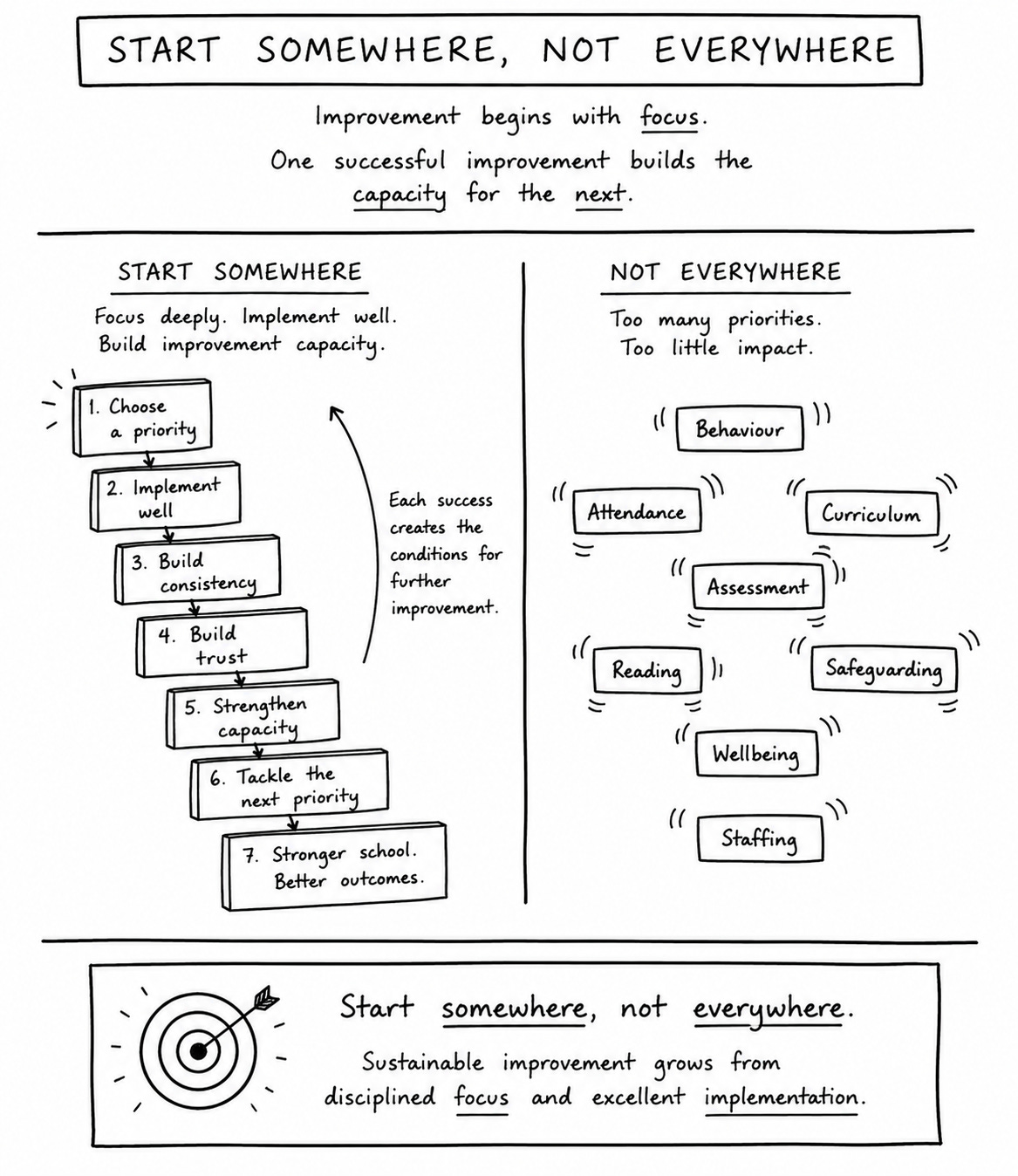
Many schools respond by attempting to improve multiple areas simultaneously. Curriculum is reviewed, assessment systems are redesigned, teaching and learning frameworks are refreshed and professional development programmes are expanded. Alongside these changes, leaders may also be addressing attendance, behaviour, safeguarding, wellbeing and a range of other priorities. Each initiative may have merit and each may be intended to improve outcomes for pupils. Yet when large numbers of changes are introduced at the same time, organisations often struggle to implement any of them particularly well.
Education is not short of good ideas. Schools have access to a substantial body of knowledge about effective teaching, curriculum design, assessment and school improvement. Most can identify areas that would benefit from attention and many have access to high-quality resources, research and expertise. Success depends less on identifying what should change and more on helping people translate knowledge into practice. Lasting improvement requires staff to develop new knowledge, adopt new habits and sustain those habits over time.
For this reason, successful improvement is often narrower than leaders initially expect. Meaningful change requires attention, repetition and follow-through. Teachers need opportunities to understand new approaches, see them modelled, practise them in authentic settings and receive feedback on their implementation. Leaders need time to monitor progress, solve problems and support colleagues as new ways of working become established. When numerous priorities compete for attention, each receives less of the time and support needed for successful implementation.
School leaders therefore face an ongoing tension. Most schools can identify several areas that would benefit from improvement and many of those areas are genuinely important. Delaying action can feel uncomfortable, particularly when leaders are aware of weaknesses that need addressing. At the same time, pursuing too many priorities often results in superficial implementation. Organisations become busy, but the quality of practice changes more slowly than intended.
A more productive approach is to begin with a small number of priorities that have the potential to make a significant difference for pupils while also strengthening the organisation's ability to improve. The precise starting point will vary from school to school. In some contexts, safeguarding may require immediate attention because it provides the foundation upon which all other aspects of school life depend. Elsewhere, behaviour may be the most pressing priority because learning depends upon pupils being able to attend, participate and focus. Other schools may decide that attendance, reading, curriculum or assessment offer the greatest opportunity for improvement.
The key consideration is not where a school begins, but whether leaders have chosen deliberately. Effective starting points tend to share several characteristics. They are important for pupils, influence multiple aspects of school life and create opportunities for staff to develop new knowledge and expertise. They also provide a meaningful opportunity to strengthen the organisation's capacity to implement change successfully.
This point deserves particular attention. Schools become stronger not only by improving individual initiatives but by becoming better at improvement itself. Every significant change requires leaders to build shared understanding, develop professional knowledge, establish clear expectations and sustain implementation over time. These capabilities are developed through experience rather than planning alone.
Consider a school that decides to strengthen behaviour for learning. Success depends upon far more than introducing a new policy. Staff require training, opportunities to rehearse routines, ongoing support and clear feedback about implementation. Leaders need to communicate expectations consistently, monitor practice carefully and respond to issues as they arise. Through this process, the school is not simply improving behaviour. It is developing the habits, routines and expertise required to implement change successfully.
The same principle applies whether the focus is safeguarding, attendance, reading, curriculum or assessment. Each improvement effort provides an opportunity to strengthen the organisation's collective capability. Teachers gain confidence in adopting new approaches. Leaders become more skilled at implementation. Professional development becomes more purposeful and more closely connected to classroom practice. Over time, schools become more capable of turning intention into execution.
This is why the first improvement priority matters so much. Its significance lies not only in the outcomes it produces but also in the lessons it teaches. A school that improves one important area well becomes better equipped to improve the next. Success creates momentum, strengthens trust and develops expertise that can be applied elsewhere. Improvement becomes cumulative, with each achievement creating the conditions for further progress.
For leaders committed to improving learning, the temptation to address every issue simultaneously will always be strong. Sustainable improvement, however, rarely emerges from the accumulation of initiatives. More often, it grows from disciplined focus, careful implementation and the willingness to improve one area exceptionally well before moving on to the next.
If learning is the central purpose of schooling, leaders must think carefully not only about what to improve but also about how improvement occurs. Schools build improvement capacity through the process of improvement itself. Lasting change starts somewhere, not everywhere. The strongest organisations begin with focused action and build from there.
References
Bambrick-Santoyo, P. (2018). Leverage Leadership 2.0: A Practical Guide to Building Exceptional Schools. Jossey-Bass.
Bryk, A. S., Gomez, L. M., Grunow, A., & LeMahieu, P. G. (2015). Learning to Improve: How America’s Schools Can Get Better at Getting Better. Harvard Education Press.
Fixsen, D. L., Naoom, S. F., Blase, K. A., Friedman, R. M., & Wallace, F. (2005). Implementation Research: A Synthesis of the Literature. University of South Florida.
Robinson, V. M. J. (2011). Student-Centered Leadership. Jossey-Bass.
Get in touch - lois@reliable-excellence.com