


Reliable Excellence explores an important question:
How do we ensure that every child experiences high-quality learning, every day?
Many schools begin with a clear commitment to helping children learn. Teachers enter the profession because they want to make a difference. Leaders devote enormous energy to improving outcomes for pupils. Governors and trustees give their time because they care about the success of schools and the children they serve. Yet maintaining a consistent focus on learning over time is often more difficult than it first appears.
Part of the challenge lies in understanding what schools are ultimately trying to achieve. Research from cognitive psychology has helped establish a widely accepted definition of learning as a relatively lasting change in what pupils know, understand and can do. Learning is not simply what pupils are doing during a lesson, and it is not the same as engagement, participation or performance. Instead, learning concerns what remains after teaching has taken place and what pupils are able to retain and apply over time.
If learning is the central purpose of schooling, it follows that schools are most successful when their decisions, systems and resources are aligned towards improving the quality of learning experienced by pupils. In practice, however, achieving and maintaining that alignment is not straightforward.
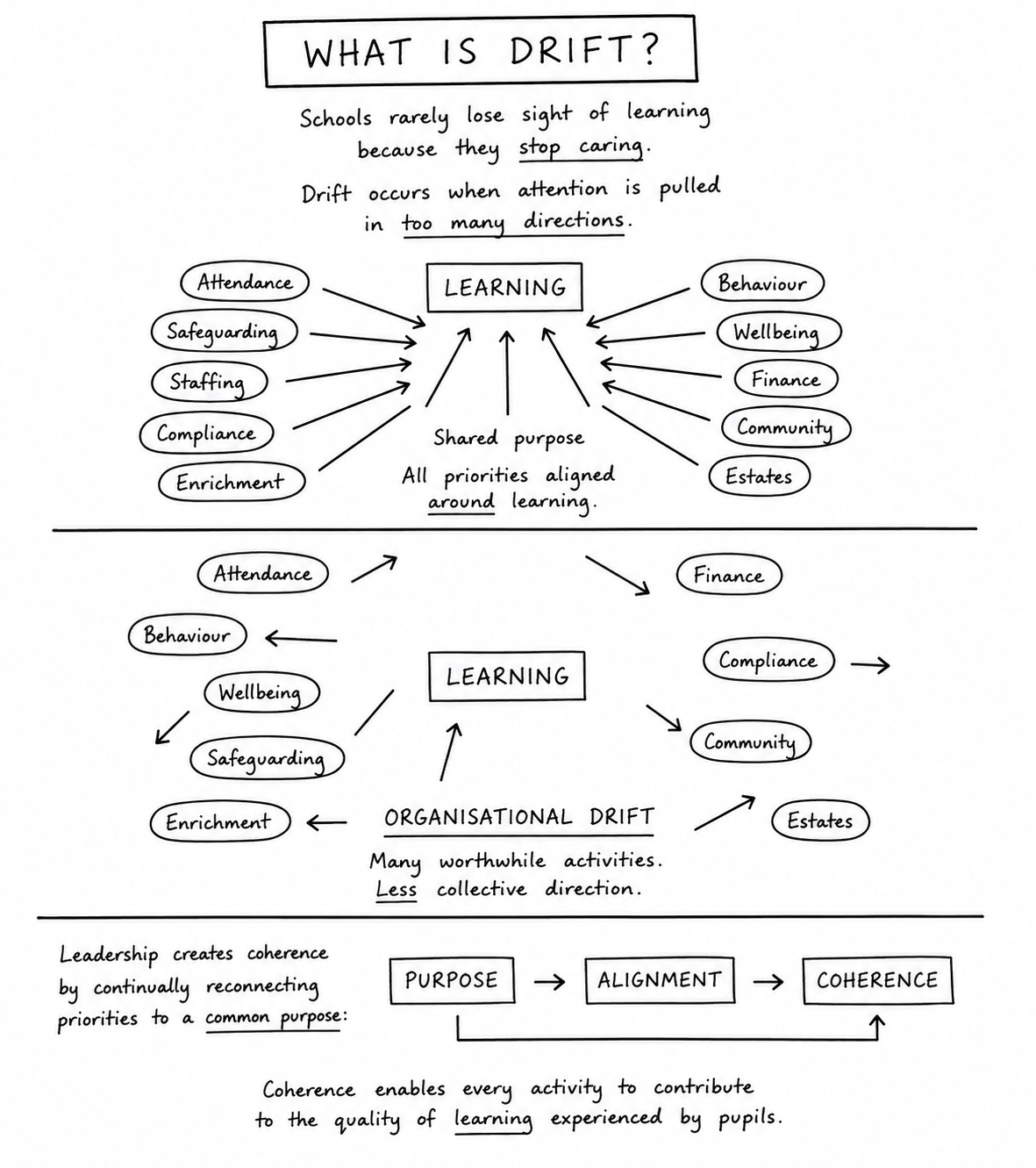
Schools are complex organisations with responsibilities that extend far beyond teaching and curriculum. Alongside learning, they must attend to safeguarding, attendance, behaviour, wellbeing, inclusion, staffing, finances, compliance, estates and community relationships. Each of these responsibilities carries significant consequences if neglected. School leaders therefore spend much of their time balancing competing demands, responding to emerging issues and making decisions across a wide range of areas.
Most people working in education care deeply about children and are motivated by a desire to help them succeed. Yet difficulties arise because the work of schools generates a constant stream of legitimate priorities, each demanding attention and each capable of making a compelling claim on limited time, energy and resources.
This tension is not unique to education. Complex organisations naturally accumulate activity over time. New concerns generate new responses, additional systems are introduced to improve accountability and initiatives are launched to address areas of need. Viewed individually, many of these decisions are sensible and well-intentioned. Difficulties emerge gradually as priorities multiply, responsibilities expand and the connections between different strands of work become less clear.
In these circumstances, organisations can become busier without becoming more effective. Staff work hard, leaders respond responsibly to challenges and teams pursue worthwhile objectives. Yet as attention becomes spread across a growing number of priorities, it becomes harder to maintain collective clarity about what matters most. The result is often a gradual reduction in organisational coherence.
This is organisational drift. Drift rarely occurs because people make poor decisions or abandon their values. More often, it emerges when immediate pressures begin to shape decision-making more powerfully than a shared sense of purpose. Over time, the original reason the organisation exists can become less visible beneath layers of activity, even when that activity is valuable in its own right.
Schools therefore do not drift because they lack commitment to learning. Rather, learning must continually compete for attention within organisations responsible for many important functions. As time and energy are directed towards an expanding range of legitimate priorities, it becomes easier for decisions to be shaped by urgency than by purpose. The consequence is not necessarily poor practice, but a gradual weakening of organisational coherence that makes it harder to ensure every activity contributes meaningfully to the quality of learning experienced by pupils.
This is why coherence matters. Coherence exists when people understand how their work contributes to a shared purpose and when decisions across the organisation are connected by a common understanding of what success looks like. Within coherent organisations, different teams may perform different functions, but those functions remain aligned because they are directed towards the same outcome.
A clear understanding of learning provides that point of connection for schools. It creates a lens through which priorities can be evaluated and decisions can be made. Rather than asking whether a new idea or initiative is interesting, popular or aligned with current trends, schools can ask a more fundamental question: how will this improve the quality of learning experienced by pupils? This helps schools evaluate competing priorities against a shared purpose and reduces the likelihood of organisational drift.
Viewing school life through the lens of learning does not diminish the importance of other responsibilities. Attendance is important because pupils cannot learn if they are absent. Behaviour is important because attention is a prerequisite for learning. Safeguarding is essential because children cannot learn effectively if they are unsafe. Staff wellbeing deserves careful attention because exhausted teachers struggle to provide consistently high-quality instruction. Financial stewardship is critical because schools require sustainable resources to support effective teaching and learning over time. Learning is therefore not one priority among many competing priorities. It is the purpose that gives coherence to them all, providing a way of understanding how different responsibilities contribute to the educational experiences and outcomes of pupils.
Maintaining this perspective requires continual effort. As organisations grow and circumstances change, people need regular reminders of what the school exists to achieve and why particular priorities have been chosen. Without this work, even successful schools can gradually lose coherence as new initiatives emerge, competing demands accumulate and attention becomes increasingly fragmented.
For this reason, leadership is ultimately an act of alignment. The role of leaders is not simply to manage complexity but to create coherence by helping teachers, leaders and governors maintain a shared understanding of purpose and ensuring that decisions, resources and priorities remain connected to the outcomes that matter most. If learning is the central purpose of schooling, schools must continually reconnect their work to that purpose, maintaining focus on what matters most: ensuring that every child experiences high-quality learning every day.
References
Bjork, R. A., Dunlosky, J., & Kornell, N. (2013). Self-regulated learning: Beliefs, techniques, and illusions. Annual Review of Psychology, 64, 417–444.
March, J. G. (1994). A Primer on Decision Making: How Decisions Happen. New York: Free Press.
Senge, P. M. (2006). The Fifth Discipline: The Art and Practice of the Learning Organization (Rev. ed.). New York: Doubleday.
Willingham, D. T. (2009). Why Don’t Students Like School? A Cognitive Scientist Answers Questions About How the Mind Works and What It Means for the Classroom. San Francisco: Jossey-Bass.
Get in touch - lois@reliable-excellence.com