


Reliable Excellence explores an important question:
How do we ensure that every child experiences high-quality learning, every day?
Answering that question begins with understanding what learning is. Research from cognitive psychology has helped establish a widely accepted definition of learning as a relatively lasting change in what pupils know, understand and can do. While learning is often inferred from performance, participation or engagement, these are not the same as learning itself. Learning concerns what remains after the lesson has finished and what pupils are able to retain and apply over time.
If learning is the central purpose of schooling, an important question follows. What implications should this have for the way schools are organised and led?
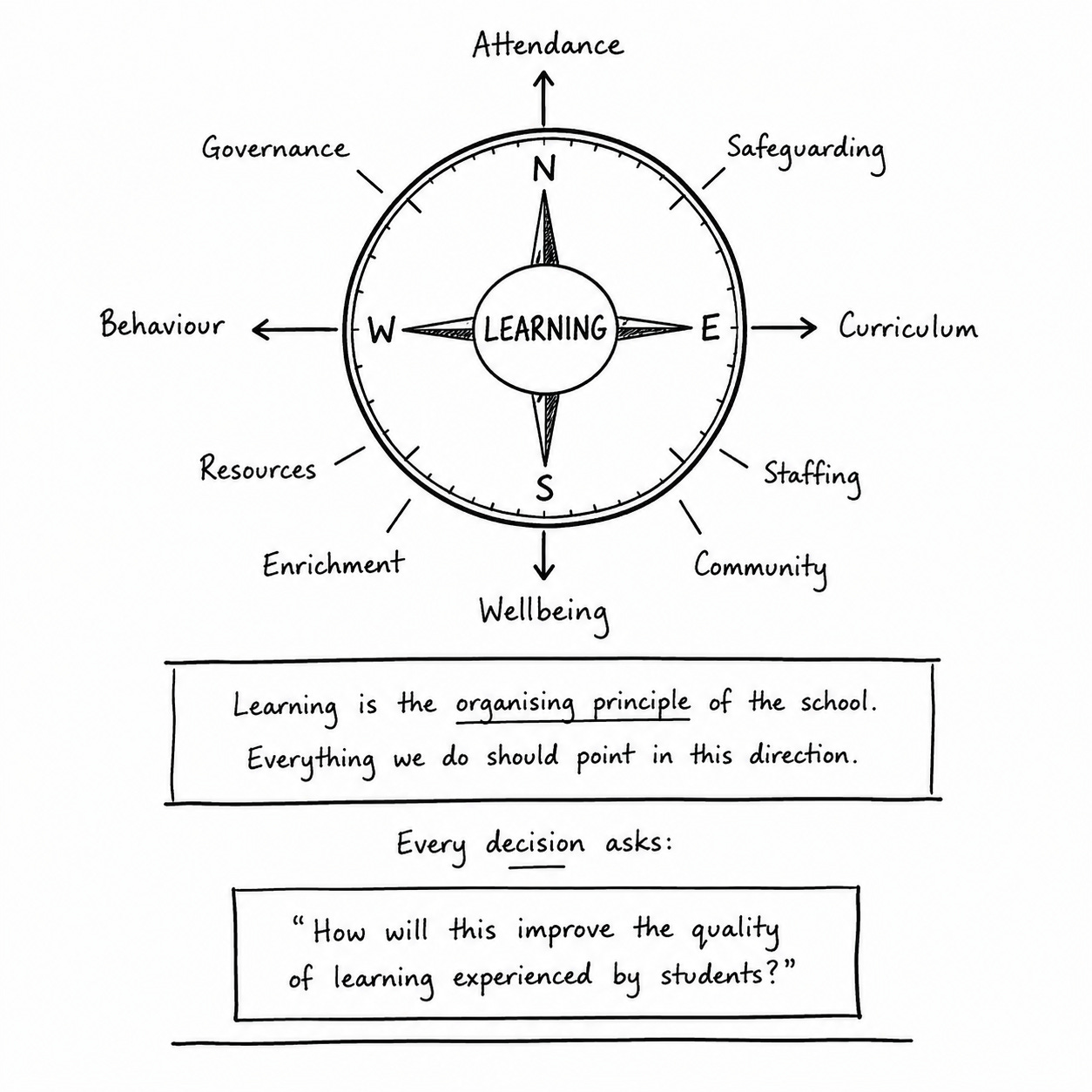
One answer is that learning should become the organising principle of the school itself. Schools are complex organisations with a wide range of responsibilities. Alongside teaching and curriculum, they must attend to pastoral care, safeguarding, wellbeing, attendance, behaviour, enrichment, staffing, finances, compliance and community engagement. Each of these matters is important, and many are essential. Yet complexity creates a risk. Without a clear organising principle, schools can gradually become collections of worthwhile activities rather than coherent organisations working towards a shared purpose.
The consequences of this are often subtle rather than dramatic. Decisions are made with good intentions, new initiatives are introduced to address genuine concerns and opportunities are pursued because they appear beneficial. Viewed individually, many of these decisions seem entirely reasonable. Over time, however, priorities can begin to multiply, resources become spread across too many areas and staff become less certain about what matters most. The result is not necessarily poor practice, but reduced coherence.
A shared understanding of learning provides a way of addressing this challenge. When leaders, teachers and governors are united by a common understanding of what the school exists to achieve, decision-making becomes clearer. Rather than evaluating proposals according to preference, tradition or enthusiasm, schools can ask a more fundamental question: how will this improve the quality of learning experienced by pupils? The value of this question lies not in providing easy answers but in providing a common direction. It encourages schools to think carefully about priorities and creates a framework through which different decisions can be evaluated.
This alignment matters because organisational consistency depends upon people working towards the same goal. Teachers may focus on classroom practice, middle leaders on curriculum, senior leaders on whole-school improvement and governors on strategic oversight. Although these groups perform different functions, they all contribute to the same educational endeavour. When each understands learning in a similar way, it becomes easier to make coherent decisions and maintain focus over time. Where such alignment is absent, schools can find themselves pursuing multiple priorities simultaneously without a clear sense of how those priorities connect to their core purpose.
Governors and trustees have a particularly important role within this process. Their responsibility is not to determine classroom practice but to help ensure that the organisation remains focused on its purpose. A governing board with a secure understanding of learning is better positioned to evaluate strategy, scrutinise priorities and allocate resources wisely. Rather than becoming absorbed by individual initiatives, governors can provide challenge and support through a consistent question: how does this contribute to the quality of learning experienced by pupils?
Viewing school life through the lens of learning does not imply a narrow conception of education. Schools exist to provide far more than academic instruction alone. Sport, music, drama, outdoor education, leadership opportunities, pastoral support and community service all contribute to children's development. The question is not whether these experiences matter, but how they contribute to what pupils know, understand and can do. When these activities are deliberately connected to a school's educational purpose, they become part of a coherent learning experience rather than a collection of disconnected additions.
This perspective also changes the way schools think about improvement. The goal is not to accumulate initiatives or respond to every new idea that emerges from research, policy or public debate. Instead, improvement becomes a process of strengthening the quality of learning experienced by pupils. Sometimes this may require introducing something new. Equally often, it may involve refining existing practice, improving implementation or stopping activities that consume time and energy without making a meaningful contribution to learning.
Ultimately, schools are at their strongest when learning provides a common point of reference for everyone involved in the organisation. Shared clarity about what learning is creates alignment between classrooms, leadership teams and governing boards. It enables schools to make decisions more coherently, direct resources more effectively and maintain focus on the outcomes that matter most for pupils.
If learning is the central purpose of schooling, then learning should also become the organising principle of the school. Only when everyone is pulling in the same direction can schools maximise the quality of learning they provide and ensure that every child experiences high-quality learning every day.
References
Elmore, R. F. (2004). School Reform from the Inside Out: Policy, Practice, and Performance.
Fullan, M., & Quinn, J. (2016). Coherence: The Right Drivers in Action for Schools, Districts, and Systems.
Senge, P. M. (2006). The Fifth Discipline: The Art and Practice of the Learning Organization.
Willingham, D. T. (2009). Why Don’t Students Like School?
Get in touch - lois@reliable-excellence.com