


Reliable Excellence explores an important question:
How do we ensure that every child experiences high-quality learning, every day?
Before we can answer that question, we first need to answer another:
What exactly do we mean by learning?
Learning is the central purpose of schooling. Children arrive each day expecting to learn, and schools are entrusted with helping them acquire knowledge, develop understanding and expand their future opportunities. Before schools can improve learning, they therefore need to be clear about what learning is.
This matters because organisations cannot reliably achieve something they have not clearly defined. If schools are serious about ensuring that every child experiences high-quality learning, they need a shared understanding of both what learning is and how it happens.
Research from cognitive psychology has significantly improved our understanding of learning. The work of researchers such as John Sweller, Daniel Willingham and Robert Bjork has helped establish a clearer picture of how knowledge is acquired, retained and forgotten. While different researchers emphasise different aspects of the process, there is broad agreement that:
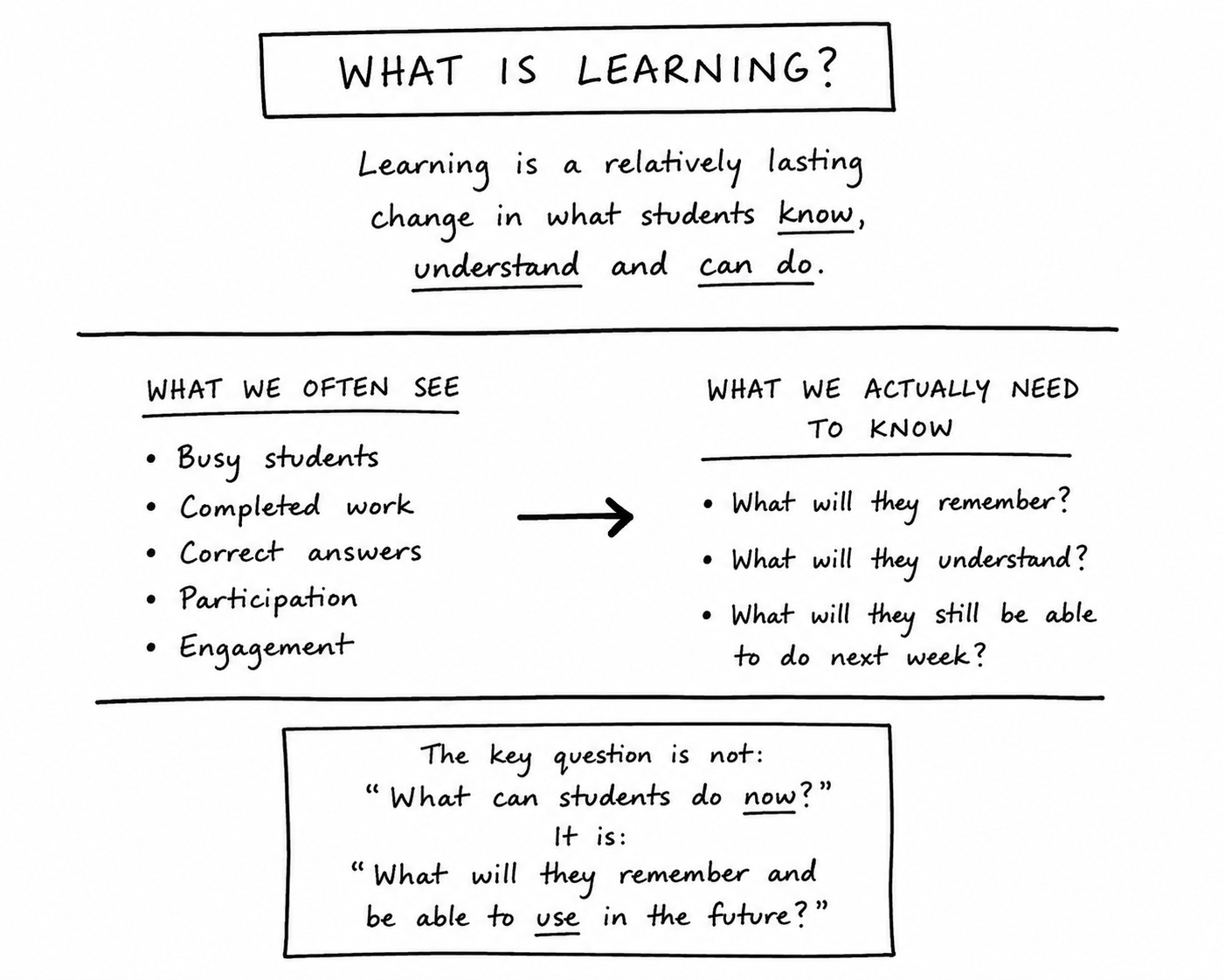
Learning is a relatively lasting change in what pupils know, understand and can do.
This definition highlights an important distinction. Learning is not simply being exposed to information, completing activities or performing successfully during a lesson. It involves changes that endure beyond the immediate experience of teaching.
The reason learning is defined as a lasting change becomes clearer when we examine how knowledge is acquired and retained. Cognitive Load Theory, developed by John Sweller, highlights that working memory has limited capacity. At any given moment, pupils can process only a relatively small amount of new information. Learning is therefore more likely when new knowledge is introduced in manageable steps and connected to what pupils already know.
As knowledge accumulates, information stored in long-term memory becomes organised into increasingly complex mental structures, often referred to as schemas. These structures allow pupils to think about ideas as meaningful wholes rather than as isolated pieces of information. A fluent reader no longer processes individual letters one at a time but recognises words and patterns automatically. An experienced mathematician sees relationships and procedures that would place far greater demands on the working memory of a novice learner. Over time, ideas that once required considerable effort become easier to access and apply, freeing attention for more complex thinking.
Daniel Willingham captures this relationship between thinking and memory through the observation that memory is the residue of thought. What pupils think about during lessons matters because learning is shaped by attention. Learning is not something that can be transferred directly from teacher to pupil. Instead, learners actively process, connect and organise new information using what they already know. If pupils are thinking deeply about the content they are intended to learn, learning becomes more likely. If their attention is focused elsewhere, learning becomes less likely regardless of how busy or engaged they appear.
This understanding also explains why successful performance during a lesson does not always indicate that learning has occurred. Robert Bjork's work demonstrates that pupils can appear highly successful while information remains temporarily available in working memory or while substantial support is being provided. Equally, activities that feel more difficult, such as retrieval practice, often strengthen learning because the effort involved in recalling knowledge helps make it more accessible in the future.
Learning therefore extends beyond what pupils can do in the moment. Hermann Ebbinghaus' work on forgetting demonstrated that knowledge is easily lost unless it is revisited and used over time. Lasting learning depends upon knowledge being strengthened, connected and retrieved repeatedly so that it remains available when needed.
These insights have important implications for schools. Curriculum sequencing becomes important because new learning is shaped by what pupils already know. Explicit instruction helps pupils manage the limitations of working memory through carefully designed explanations, modelling and guided practice. Retrieval practice helps strengthen memory and improve long-term retention. Checking for understanding provides teachers with accurate information about what pupils have learned and where further teaching may be required.
Although these practices may appear different, they are grounded in the same understanding of learning. The goal is not simply to cover content, complete activities or deliver lessons. The goal is to ensure that pupils acquire knowledge, retain it over time and can draw upon it when needed in the future.
If we are serious about ensuring that every child experiences high-quality learning every day, we must begin with a clear understanding of what learning is and how it happens. Only then can we judge whether our curriculum, teaching and organisational systems are making learning increasingly likely for every child.
References
Bjork, R. A., & Bjork, E. L. (2011). Making Things Hard on Yourself, But in a Good Way: Creating Desirable Difficulties to Enhance Learning.
Elmore, R. F. (2004). School Reform from the Inside Out: Policy, Practice, and Performance.
Fullan, M., & Quinn, J. (2016). Coherence: The Right Drivers in Action for Schools, Districts, and Systems.
Sweller, J., Ayres, P., & Kalyuga, S. (2011). Cognitive Load Theory.
Willingham, D. T. (2009). Why Don’t Students Like School?
Get in touch - lois@reliable-excellence.com